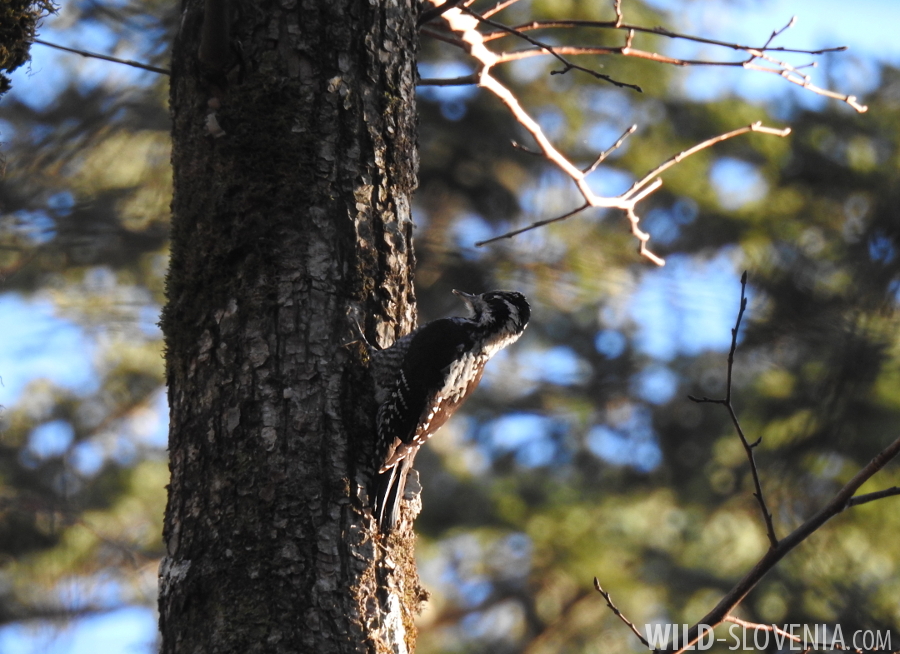
Another year is coming to an end, so it's time to summarise our best wildlife moments of 2018. In spring and part of the autumn we've been busy guiding tours for different companies like Naturetrek, Honeyguide and Wildlife Worldwide, as well as local tour operators. In winter, spring and part of late summer we also carried out several censuses and bird monitorings for DOPPS-BirdLife Slovenia, as usual. In summer we concentrated mostly on butterflies, looking for species we haven't seen yet and added many lifers. However we also enjoyed in the usual botanising and birding, as well as the underwater wildlife of the Adriatic sea. 2018 has been a very successful year for Brown Bear observations: we have seen a total of 16 different bears this year, 9 of which were from bear-watching hides, while the other 7 were found by chance in the forest and were perhaps even more thrilling than those seen from the hides! Even more amazing was an extremely rare sighting of a Wolf in April, ranking among the major highlights of our entire life so far! This year we've been lucky to spend quite a lot of time in our favourite environment (forest), tracking, studying and showing to our guests iconic species such as Ural Owl and Three-toed Woodpecker.
The selection is arranged in chronological order and includes wildlife observed in Slovenia, except for a few pics that we took in nearby Trieste (Italy) or in Croatia. Somehow the photo selection seems to be getting longer every year... :-) Nevertheless, enjoy!
The selection is arranged in chronological order and includes wildlife observed in Slovenia, except for a few pics that we took in nearby Trieste (Italy) or in Croatia. Somehow the photo selection seems to be getting longer every year... :-) Nevertheless, enjoy!
 |
| Wallcreeper Tichodroma muraria, Karst edge, January. Watch the video. |
 |
| Ural Owl Strix uralensis, wintering in the Karst near Sežana, January. A local rarity. |
 |
| Eagle Owl Bubo bubo, Karst edge, March. |
 |
| Dog's-tooth Violet Erythronium dens-canis, Karst, March. |
 |
| Middle Spotted Woodpecker Dendrocopos medius, Karst, March. Our traditional spring census revealed 5 new territories at new locations in western Slovenia, where the species is scarce and localised. |
 |
| Red-necked Grebes Podiceps grisegena courting at lake Cerknica, April. |

 |
| Ural Owl Strix uralensis (dark morph), Loški Potok, April. We observed this cooperative bird several times from the beginning to the end of April, as it used a very small hunting area. We also documented one of its successful hunts (top pic). |
 |
| Brown Bear Ursus arctos, Loški Potok, April. This year we were lucky to escort several visitors to bear-watching hides and thus we enjoyed several close encounters with Slovenia's most charismatic animal. |
 |
| Three-toed Woodpecker Picoides tridactylus, Loška dolina, April. A new bird discovered at a new location during a census. |
 |
| Common Crane Grus grus, Planinsko polje, April. |
 |
| Wolf Canis lupus (photo by Alberto Nevola), Cerkniško jezero, April. This truly mega encounter was certainly one of the most exciting of the whole year! We observed the wolf in complete daylight on the last day of our Wild Slovenia tour to the Notranjska region, while the group was returning home after 4 days packed with the very best of Slovenian wildlife. |
 |
| Brown Bear Ursus arctos, Javorniki mountains, April. This cooperative male bear, observed at the side of a forest road was one of the 3 bears seen during our Wild Slovenia tour. |
 |
| Wildcat Felis silvestris, Loški Potok, April. Another excellent find during our Wild Slovenia tour to the Notranjska region. |
 |
| White-backed Woodpecker Dendrocopos leucotos, Snežnik, April. This male was observed during our Wild Slovenia tour. |
 |
| Enjoying a Ural Owl Strix uralensis in the Javorniki-Snežnik forests during our Wild Slovenia tour in April. |
 |
| Marsh Fritillary Euphydryas aurinia, Karst, May. Marking the start of the "fritillary season" and the butterfly season in general. |
 |
| Wild Peony Paeonia officinalis, Karst, May. |
 |
| Eastern Stone Grasshopper Prionotropis hystrix, Karst edge, May. An Illyrian endemic grasshopper of sub-Mediterranean dry grasslands. |
 |
| Ural Owl Strix uralensis, Loška dolina, May. Watch the video. |
 |
| Collared Flycatcher Ficedula albicollis, mount Snežnik, May. A rare breeding bird in mountain Dinaric forests. |
 |
| A patch of old-growth forest on the northern slopes of mount Snežnik, where during two visits in May we observed all the main Slovenian forest specialities including Brown Bear, Ural Owl, Three-toed and White-backed Woodpecker, as well as Collared Flycatcher. |

 |
| Brown Bear Ursus arctos, Loški Potok, May. One of the 9 bears observed from the hides during the Brown Bear Weekend organised by Wildlife Worldwide for the readers of BBC Wildlife Magazine. |
 |
| Summer Bolete Boletus aestivalis (B. reticulatus), Javorniki mountains, May. |
 |
| Birding in the Dinaric forests during the Brown Bear Weekend in May. |
 |
| Photographing White Storks Ciconia ciconia at lake Cerknica during the Brown Bear Weekend in May. |
 |
| Black Woodpecker Dryocopus martius, Karst, May. Watch the video. |
 |
| Carniolan Lily Lilium carniolicum, mount Nanos, May. |
 |
| Rock Thrush Monticola saxatilis, mount Nanos, May. |
 |
| Clouded Apollo Parnassius mnemosyne, mount Nanos, May. |
 |
| Kojnik's Iris Iris sibirica ssp. erirrhiza, mount Nanos, June. |
 |
| In early June we took around our friend Peter on a two-day general wildlife tour to southern and western Slovenia. We explored a wide variety of habitats and enjoyed mostly butterflies, plants as well as Ural Owl and a few other breeding birds. |
 |
| Ural Owl Strix uralensis, Loška dolina, June. An adult male close to its nest-box which has been successfully occupied earlier in the season. |
 |
| Three-toed Woodpecker Picoides tridactylus, Javorniki mountains, June. After an extensive search we discovered this nest in late May and kept an eye on it until mid June. We also accompanied several small groups to see it; the guests could watch these fantastic and rare birds from a safety distance with the aim of telescopes. |

 |
| Poplar Admiral Limenitis populi, Snežnik forests, June. This rare species is Slovenia's largest butterfly and was certainly the butterfly highlight of the year! We saw at least two during the Naturetrek's Wild Slovenia tour in June. |
 |
| Owlfly Libelloides macaronius, Karst, June. A common species of Karst meadows observed during Naturetrek's Wild Slovenia tour. |
 |
| Yellow Daylily Hemerocallis lilioasphodelus, Iška river, June. One of the plant highlights during Naturetrek's Wild Slovenia tour. |
 |
| Paul in front of a stand of Scopolia carniolica on mount Slivnica, giving a history lesson about J.A. Scopoli to the Naturetrek group during the Wild Slovenia tour in June. |
 |
| Naturetrek group at lake Cerknica during the Wild Slovenia tour in June. |
 |
| In June we also took some time off and went canoeing on lake Cerknica, enjoying the freshwater wildlife, especially all the amphibious plants. |
 |
| Purple Emperor Apatura iris, Rakov Škocjan, June. |
 |
| Mountain pic-nic for the group during Naturetrek's Julian Alps botanical tour in June. |
 |
| Carniolan Lily Lilium carniolicum, Soriška planina, June. One of the plant highlights during Naturetrek's Julian Alps tour. |
 |
| Yellow Bellflower Campanula thyrsoides, Soriška planina, June. During Naturetrek's Julian Alps tour. |
 |
| Red Vanilla Orchid Nigritella rubra (N. miniata), Pokljuka plateau (Triglav National Park), June. During Naturetrek's Julian Alps tour. |
 |
| Zois' Bellflower Campanula zoysii, Vrata valley (Triglav National Park), June. One of the most interesting finds during Naturetrek's Julian Alps botanical tour. |
 |
| Scarce Copper Lycaena virgaureae, Mostnica (Triglav National Park), June. The butterfly highlight during Naturetrek's Julian Alps tour. |
 |
| Female Capercaillie Tetrao urogallus (photo by Peter Burgess) walking a forest road on the Pokljuka plateau (Triglav National Park), during Naturetrek's Julian Alps tour in June. Unfortunately this bird was seen only by the few lucky participants sitting in the front van. |
 |
| Naturetrek's botanical group enjoying the tiny Lesser Twayblade Listera cordata in the forests of Pokljuka in June. |
 |
| Lesser Grey Shrike Lanius minor, Vipava valley, July. Despite the very small size of the Slovenian breeding population, the colony in the Vipava valley seems to be doing well. This summer we observed several fledged juveniles. |
 |
| Chasing butterflies in the dry grasslands at the southern edge of Trnovski gozd in July. |
 |
| Styrian Ringlet Erebia stirius, southern edge of Trnovski gozd, July. A rather localised mountain butterfly of the South-eastern Alps. |
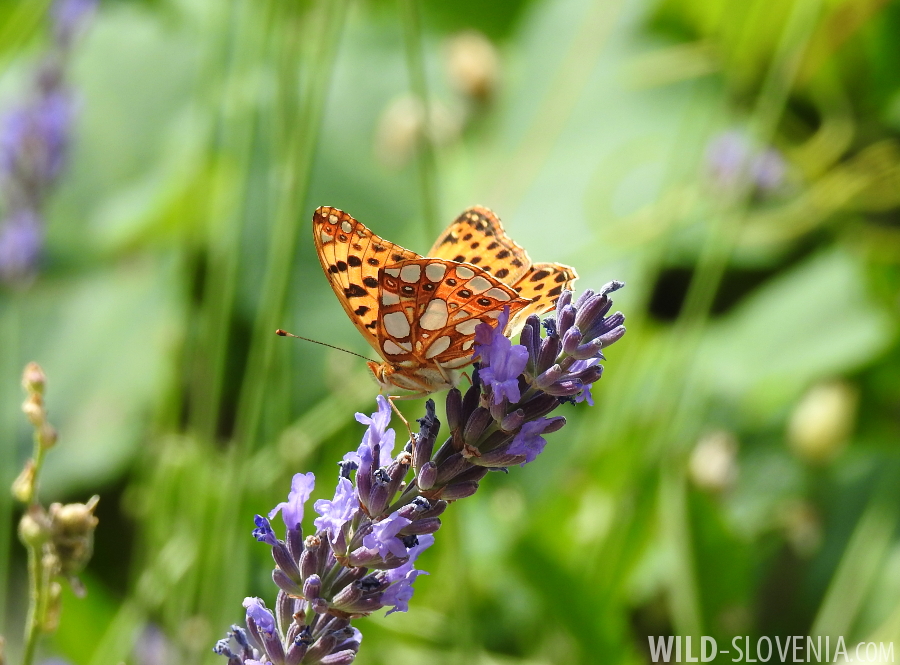 |
| Queen of Spain Fritillary Issoria lathonia in our garden in the Karst, July. |
 |
| Apollo Parnassius apollo, southern edge of Trnovski gozd, July. After several fruitless visitis this and the previous summer, we finally found a site where we observed up to 7 of these charismatic and very rare butterflies. |
 |
| We must've seen +20 "Beech Longhorn Beetles" Morimus funereus this summer, while on a quest to find its rarer cousin - the Rosalia Longicorn Rosalia alpina. |
 |
| In July we also went on a sea & wildlife holiday to Croatia, where we observed, among others, several Rock Nuthatches Sitta neumayer. See here the complete report. |
 |
| Queen of the Alps or Alpyne Eryngo Eryngium alpinum, mount Črna prst, August. A summer visit to the queen of all alpine plants has become traditional in recent years. The species is extremely rare in Slovenia and grows only on a handful of mountains. |
 |
| Golden Eagle Aquila chrysaetos with a Honey Buzzard Pernis apivorus in the talons, on mount Nanos in August (see here for complete account on this extraordinary sighting). |
 |
| Dryad Minois dryas on Amethyst Eryngo Eryngium amethystinum, Karst, August. Both the butterfly and the plant are characteristic sights of late summer in the Karst. |
 |
| Lorkovič's Brassy Ringlet Erebia calcaria on Edelweiss Leontopodium alpinum, mount Vogel, August. This butterfly is endemic of the Julian Alps & Karavanke of NW Slovenia and the Alps of NE Italy. |

 |
| Zois' Bellflower Campanula zoysii, mount Vogel, August. Endemic species of the Julian, Carnic & Kamnik-Savinja Alps and Karavanke (hence the t-shirt!). |
 |
| Tufted Horned Rampion Physoplexis comosa, Kriški podi (Triglav National Park), August. |
 |
| Lower Križ lake on the Kriški podi plateau (Triglav National Park), August. |
 |
| Shepherd's Fritillary Boloria pales, Kriški podi (Triglav National Park), August. A rather rare high-altitude butterfly we encountered several times this year during our mountain excursions. |
 |
| Alpine Ibex Capra ibex, Kriški podi (Triglav National Park), August. |
 |
| Alpine Chamois Rupicapra rupicapra, Kriški podi (Triglav National Park), August. |
 |
| Relaxing by the mountain hut at Kriški podi, after a 4 hours hike uphill. |
 |
| Rosalia Longicorn Rosalia alpina, found dead in the Trenta valley, August. The quest goes on next year... |

 |
| Goldline Sarpa salpa (above) and Greater Weaver Tracinus draco (below) in the Adriatic sea. More on our summer snorkeling in this post. |
 |
| Loggerhead Turtle Caretta caretta, Duino-Devin (Gulf of Trieste), September. A regular, but difficult-to-see species in the Gulf of Trieste; this individual spents most of the summer under the sea cliffs of Duino. |
 |
| Pelagic Stingray Pteroplatytrygon violacea, Trieste, October. A pelagic species, as the name suggests; this individual apparently lost its way and remained blocked in a sea canal in the town of Trieste for several weeks, before being caught and released into the open sea. |
 |
| Large Copper Lycaena dispar, Vipava valley, September. |
 |
| Brown Bear Ursus arctos, Loška dolina, September. With a few more bear sightings in autumn, our yearly tally rose to 16 different bears seen in 2018! |
 |
| Bronze Bolete Boletus aereus, Karst, September. A huge specimen - the most exciting mushroom find this autumn. |
 |
| Ural Owl Strix uralensis, Karst, September. One of 3 birds observed repeatedly in September in a forest not far from Sežana, suggesting a possible colonisation of the species into western Slovenia. Watch the video. |
 |
| Three-toed Woodpecker Picoides tridactylus, mount Snežnik, September. |
 |
| Primeval Dinaric forest of beech Fagus sylvatica and silver fir Abies alba on mount Snežnik, September. |
 |
| Osprey Pandion haliaetus, Medvedce reservoir, September. One of two birds observed on the same day. |
 |
| White-backed Woodpecker Dendrocopos leucotos, Snežnik forests, October. In autumn we were lucky to observe two females on the same day, in an area where the species' densities are rather low. Watch the video. |
 |
| Pygmy Owl Glaucidium passerinum, Snežnik forests, October. This rare little owl was one of the highlights of the Autumn Forest Birding tour to Notranjska. |
 |
| Ural Owl Strix uralensis, Snežnik forests, October. Several were observed during the Autumn Forest Birding tour. |
 |
| Sweet Chestnut Castanea sativa, Karst, October. 2018 was an exceptionally productive year for nature's fruits, seeds and berries. |
 |
| Autumn Emperor Moth Perisomena caecigena, Karst edge, October. |
 |
| Phone-scoping a Ural Owl Strix uralensis in the Javorniki mountains in November. |
 |
| Greater Spotted Eagle Clanga clanga, Istria (Croatia), November. See post. |
 |
| Yellow-billed Loon Gavia adamsii, Duino-Devin (Gulf of Trieste), December. A great rarity in our areas; less than 10 records exist for the whole of Italy. See post. |
 |
| Nutcracker Nucifraga caryocatactes, Postojna, December. Watch the video. |
We'll end the post with our recent video featuring
forest birding and bear watching in Slovenia.
Enjoy & see you in 2019!