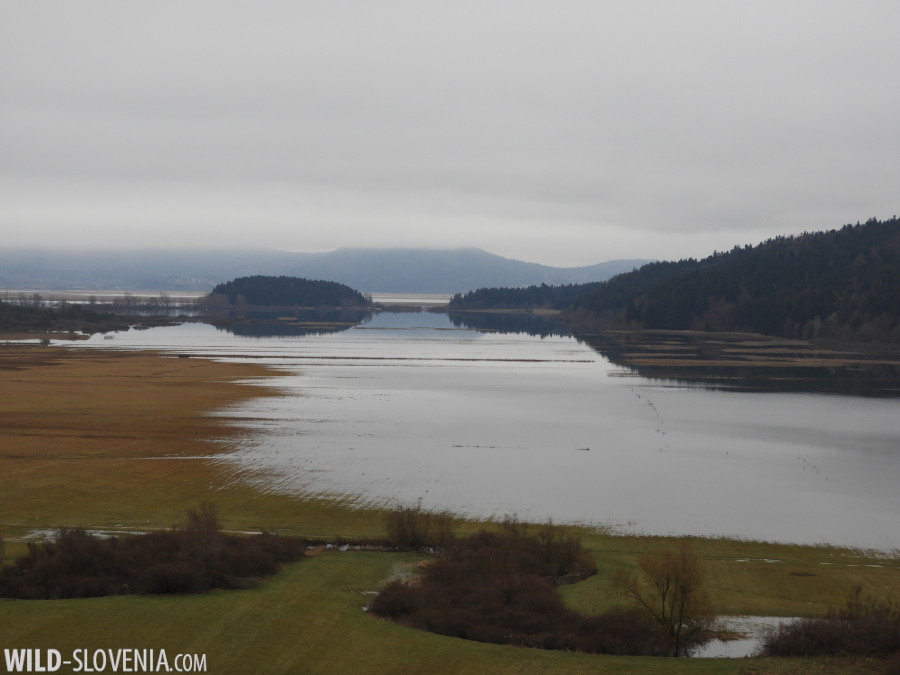
The karst's most basic characteristic is its limestone composition and thus the near-absence of surface water. The latter is actually present, but mostly invisible, stored in the form of groundwater in caves and underground rivers. However in certain seasons, when heavy rainfalls concentrate over a short period of time (usually in a few days), the underground reservoirs are quickly filled and water spills on the surface. Sinkholes that usually absorb water, transfrom into violent springs, while dry poljes (karstic floodplains) turn into lakes. Lake Cerknica is the most classical example of this phenomenon, but there are many others all over the central and western part of Slovenia, where limestone is the main type of bedrock. The Notranjska region is particularly rich in karstic phenomena, especially those involving "flood water", while the "Classical Karst" region to the west (the one which we write with a capital "K", to emphasize the name of the place) remains mostly dry. Like (almost) every autumn, in the past two weeks we experienced heavy rainfalls that brought a considerable amount of water to the karstic landscape. As wildlife is really thin on the ground at this time of year, we sometimes like to go out looking for interesting physical features of the natural world, especially so because we have them all around us in the Karst where we live.
Over the weekend we payed a short visit to lake Cerknica which was quite full of water, but held few birds. Wildfowl numbers were quite low, however we managed to spot the "usual" White-tailed EagleHaliaeetus albicilla, an adult perched distantly in the middle of the lake. Several winter species like Great Grey ShrikeLanius excubitor and Hen HarrierCircus cyaneus (two males) were around, but what made our day was a large flock of 250-300 FieldfaresTurdus pilaris feeding in a field by a village. We also had GoshawkAccipiter gentilis, RedwingTurdus iliacus and a large flock of HawfinchesCoccothraustes coccothraustes.
NW corner of the Cerknica floodplain, filled with water.
Reflections on lake Cerknica.
White-tailed EagleHaliaeetus albicilla
Great Grey ShrikeLanius excubitor
FieldfareTurdus pilaris
Given the circumstances we also checked the water levels at nearby Rakov Škocjan and Planina cave, that represent the natural continuation of the waters flowing out from lake Cerknica. The rivers Rak and Unica gave us some inspiration to record a little video (below is the result). The only bird of note was a DipperCinclus cinclus on the river Unica, as usual coping very well with the high water table. The violent karstic springs such as those at Rakov Škocjan (but especially those of the river Pivka) are sometimes so strong that they bring to the surface underground dwellers like the mysterious Olm Proteus anguinus, the charismatic cave-salamander, endemic to the karst around the Adriatic (see here).
Rivers Rak & Unica.
A spring of the river Rak at Rakov Škocjan.
The entrance to Planinska jama (Planina cave) & the river Unica.
DipperCinclus cinclus
Although as we mentioned above, the "Classical Karst" where we live is much drier even in rainy times (water persists only deep down in the caves), there are still some places where the limestone rock gives way to sandstone (flysch), creating steep valleys with small temporary and permanent streams. The Kranjšek stream near Sežana is a nice example. In the past there used to be several mills along its relatively short course. The valley is now abandoned and mostly overgrown with spontaneous vegetation, including ferns of all sorts. The several small, but scenic waterfalls are adorned by fallen and rotting trees creating natural dams. A little corner of karstic wilderness. Here too we took the chance to record a few waterfalls and make a small video (watch below). The surrouding oak forests, which we visited several times in the last two weeks, provided multiple encounters with Middle Spotted WoodpeckersDendrocopos medius, an ever increasing species in mature karstic woodlands, as well as a nice WoodcockScolopax rusticola. The oak trees at this time of the year are also adorned by the incredibly beautiful golden fruits of the Yellow-berried MistletoeLoranthus europaeus - one of the few touches of colour in the grey winter landscape.
Waterfalls on the Kranjšek stream.
Epiphytic PolypodiesPolypodium vulgare on fallen trees give a primeval-like appearence.
Yellow-berried MistletoeLoranthus europaeus
A typical view of a Middle Spotted WoodpeckerDendrocopos medius.
Due to a considerable amount of indoor desk work and the current restrictions, lately we've been mostly confined to our home area in the Karst around Sežana. We only made short walks in the woods and meadows close to home, which wasn't that bad actually, given the fact that with the increasingly wintry weather, wildlife is thin on the ground and can be enjoyed conveniently in small, daily "pills". One such super-concentrated pill was a couple of hours spent in the oak-beech woodlands where we payed a visit to our local pair of Ural Owls Strix uralensis. We spotted the two birds resting together on a Scots Pine Pinus sylvestris at a usual site, where we see this pair on a regular basis. The owls apparently know us well (we've been following them for several years) and never seem too bothered by our presence. This time they were taking a nap on the pine and seemed super relaxed, something that is obvious in the video below. Note at min 1:20 the two birds sitting together on the same branch.
Ural OwlStrix uralensis (last pic taken on another recent occasion).
While sitting quietly, watching the owls a group of +10 female Red DeerCervus elaphus trotted by, followed later by two handsome males with nice antlers. Red Deer is a widespread species across Slovenia, but was absent from the Karst until only a few decades. Nowadays it is well established and especially common in larger stretches of oak forests on the eastern edge of the Karst. Nevertheless, for us it still remains an amazing sight in this part of Slovenia. Among birds there were all the common woodpeckers of this area, including Middle SpottedDendrocopos medius and Black WoodpeckerDryocopus martius. Numerous RedwingsTurdus iliacus were feeding on the ground in the company of tens of Blackbirds Turdus merula, while the trees were very lively with common forest birds of all sorts. A Fire SalamanderSalamandra salamandra crawling in the leaf litter was also nice to see so late in the season. Out in the open, on the meadows a Great Grey ShrikeLanius excubitor (a winter guest to Slovenia) was showing nicely on a bush.
Fire SalamanderSalamandra salamandra
Marsh TitPoecile palustris opening a beech's seed.
Great Grey ShrikeLanius excubitor
At last we also got some more CranesGrus grus migrating through the Karst. We saw two larger flocks (130 and 265) passing right above our house on the 21st of November, although the passage seemed rather weak overall. The beginning of December might still bring some more flocks.
As autumn slowly turns into winter, the mountain forests of the Dinaric region fall incredibly silent and empty. Above 1000 metres most of the deciduous trees already shed their leaves by the end of October, leaving the forest to a dull grey colour. However wildlife is still around and can be observed with a bit of luck and knowledge. At this time of year the conifer stands are usually richer with birds, whereas in the beech forests, total silence is broken only by the occasional mixed flock of birds that appear as if by magic and quickly vanish again. During recent fieldwork in the Snežnik mountain range we came across several of the (usual) interesting birds inhabiting the altitude between 1000 and 1400 metres a.s.l.. In a karstic dolina (sinkhole) covered by Norway spruce Picea abies we tracked down a confiding male Three-toed Woodpecker Picoides tridactylus feeding on fallen conifer trunks (see video below). This type of feeding behaviour seems to be common especially in males which like to feed very low down, sometimes even on the ground. Interestingly, we noted the same type of behaviour in male White-backed Woodpeckers Dendrocopos leucotos, whilst females tend to feed higher up on trees and on side branches. The latter species was (is) actually our main survey target and this time we managed to track down and observe a rather mobile female White-back, feeding on contorted beech trees close to a Great Spotted Woodpecker D. major and within a mixed flock of small forest birds. In the same area a surprisingly large flock of Bramblings Fringilla montifringilla was feeding on the ground on fallen beech mast, a particularly abundant source of food this year. Several hundred Bramblings were "streaming" through a small ridge in the forest for several minutes. Overall this autumn the species seems to be very numerous in mountain beech forests. Given the abundant beech crops, another winter invasion such as the one in 2019 wouldn't be surprising. Finally among interesting birds we also heard several hooting Ural Owls Strix uralensis among which we also observed a male at close quarters.
Three-toed WoodpeckerPicoides tridactylus, male.
The edge of a forest reserve, marked with a double blue line.
BramblingFringilla montifringilla, male (above) & female (below).
Other forest animals are also still active, especially in the conifers, such as the several Red SquirrelsSciurus vulgaris we observed gathering food on the woodland floor or the noisy herd of Wild BoarsSus scrofa that we surprised rustling in the leaf litter. Red Deer Cervus elaphus are basically everywhere although their presence can be noticed only by their signs. Brown Bears Ursus arctos are also still active, as the numerous droppings and feeding signs testify, although some of them might have already moved to their winter dens.
Red SquirrelSciurus vulgaris
A Brown Bear Ursus arctos has been digging hard and turning stones.
A probable bear's den, under a rocky block, with signs of turned stones and dug up earth.
Brown Bear's claw signs on a trunk crossing a wildlife "corridor".
A wildlife "corridor" where deer, boars and bears have "consumed" a fallen trunk by passing over it (and through it) repeatedly.
Meanwhile lower down in the Karst around Sežana we've been visiting our usual circuits within short reach from home. Given the fine and sunny autumn weather with northeasterly winds we expected to see some good migration of Common CranesGrus grus. However the migration of this species over western Slovenia has been very weak so far. Nevertheless on the 8th of November we saw a flock of 4 individuals arriving from the Razdrto area and migrating above the Divača-Sežana area. Next, on the 17th we saw 3 small flocks, all from the top of a small panoramic hill behind our house: 6 passed low above our head, 16 flew above Lipica and about 20 were seen very distantly, somewhere above Dutovlje-Komen. All flocks were heading westwards as typical for this season. Hopefully more larger flocks will follow in the coming weeks.
As lately we've been spending so much time indoors in front of the pc (smart working ect.), we've also been out on walks around home more often than usual. The discovering of hidden wild places that we initiated during the spring lockdown therefore continues. After our fantastic encounter with the Golden JackalCanis aureus (see previous posts) we had several more sightings of this species. One day as we were setting a camera trap in the vicinity of the site where we saw this, a Jackal appeared out of nowhere and approached us, down to 10 metres, before realising our presence and fleeing. The camera trap results have been of course very productive. Another Jackal was seen some days earlier, while we were scanning a scrubby hill, where we also spotted two male Red DeerCervus elaphus - another increasingly common mammal in the Karst, but more typical of montane forests. Among birds there were the usual multiple encounters with Middle Spotted WoodpeckersDendrocopos medius as well as all the other commoner woodpeckers and Common TreecreeperCerthia familiaris (always an interesting find in the Karst). During a short vis migging session we also had the first Hen HarrierCircus cyaneus of the season (a nice male), migrating over the Karst.
A couple of days ago we also made an afternoon walk on the hill called Veliki Medvedjak (473 m), very close to Sežana and right on the border with Italy, where we enjoyed a superb view over most of the Karst, the western part of Slovenia and north-east Italy. Walking back in the evening, a hooting Eagle OwlBubo bubo rounded up our walk perfectly. We certainly can't complain about our local patch!
Common CraneGrus grus
Golden JackalCanis aureus in the field (above) and on camera trap (below).
Red DeerCervus elaphus - young male; above together with a stag (in the right corner).
Thermophilous woodland with limestone screes - habitat of Golden Jackal and Red Deer in the Karst.
BeechFagus sylvatica
Basket StinkhornClathrus ruber
Cool deciduous woodland on flysch in the Karst - from the outside...
...and inside.
View over the town of Sežana from Veliki Medvedjak (473 m), looking east.
Mt. Snežnik with its plateau is visible in the background.
Snežnik's summit (1796 m) sticking from behind the Sedovnik hill (575 m) above Sežana.
The "Sežana plain" with the villages of Orlek (far right) and Lipica (far left). The large hill in the centre is Kokoš (670 m), while the mountain in the distance is Slavnik (1028 m).
View east from Veliki Medvedjak hill.
A look towards Primorska's main landmark - Mt. Nanos (1262 m) with the village of Štorje in the foreground.
View north over the Karst of Komen (foreground) and the Trnovo forest plateau in the background.
The iconic village of Štanjel on the edge of the Karst and the mountains on the Trnovo plateau: Mt. Čaven-Mala Gora (1032 m) and the Golaki Mts. (1495 m).
Another look north, behind the Trnovo plateau with the imposing mount Krn (2244 m) in the Julian Alps.
Mt. Triglav (2864 m) - Slovenia's "father", this time seen from Strunjan on the Adriatic coast.
Sunset from Medvedjak, over the Trieste Karst and towards the Adriatic sea.