Friday, 2 August 2013

August at last!

Škocjanski zatok NR: autumn migration is kicking in and it's getting quite lively in the wetland. The main problem now is the limited visibility on the overgrown freshwater marsh, which usually hides the best birds (impossible to see if not flushed by the cattles). Fortunately the wardens have begun with the mowing, so in a few weeks we should have a very nice view across the area. Yesterday morning a juvenile Black Tern (above) was of note and one of the Glossy Ibises was still around (feeding in the brackish lagoon). Wood Sandpiper numbers are building up (15 ind.) as are those of other waders like Common and Green Sandpipers, Snipes (4 yesterday), Curlews and so on. A juvenile Med Gull was in the lagoon - a scarce bird at the reserve. Little Egrets have also reached good numbers with up to 121 counted yesterday. Also 2-4 Night Herons and 13 Pygmy Cormorants and still 38 Common Terns in the lagoon. Other birds of note included Turtle Dove, Yellow Wagtail and a family of Nightingales.
A few days ago one of the wardens also recorded the first Little Crake of the autumn.

Local patch: yesterday in the evening I had the pleasure to listen to the song of a Nightjar, while relaxing on the armchair at my sister's home. The bird performed the long an insisting song for most of the evening and included in its repertoire lots of "kuuik" calls, wing-clapping and every kind of eerie calls. A Nightingale was also whistling nearby and after a while a Scops Owl began to sing. All in all a pleasant local patch chorus from the comfort of the armchair!

Tuesday, 30 July 2013

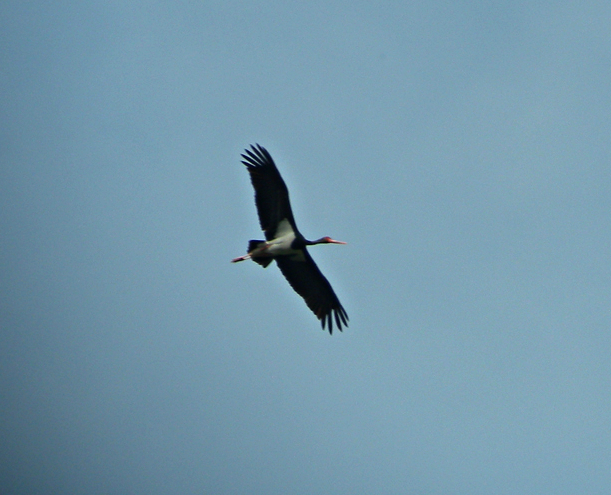
Black Stork

Today in the afternoon I was around Divača on the Slovenian Karst and I had about 15 minutes of spare time before an appointment. With a potential Black Stork in mind I headed towards Vremska dolina, a few kilometres away, where indeed an adult BLACK STORK was soaring above the valley. I first spotted it while still driving and then continued to watch it when I stopped at the side of the road. The bird performed well for a few minutes, before dropping down into some distant fields. Always quite a thrill to watch this rare species.
A mix of luck combined with good timing and a bit of knowledge about the local breeding pair - actually the nearest to Trieste (30 min drive away).

Wednesday, 24 July 2013

Unforgettable evening

Three magnificent Red Deer stags with massive antlers graze on the meadows along with another two diminutive Roe Deers. Down in the valley a Quail sings and Hoopoes fly around. As the sun sets, a chorus of Nightjars begins. You turn your back and find there's a full moon rising, then you point your scope towards a distant planet and find out it's the gorgeous Saturn with its distinctive rings. Night sets in and the only thing you hear is the Nightjars' churring, accompanied by the thousands of crickets and grasshoppers.
Priceless!   

Friday, 19 July 2013

Hoopoes

Yesterday in the late afternoon I was back on the Slovenian Karst in the same old area that I regularly visit throughout spring and summer. Red-backed Shrike was by far the most numerous species with up to 30 birds seen. But perhaps the most notable observation was that of 6 Hoopoes feeding on a recently mowed meadow. When a Sparrowhawk approached from the nearby woodland, they all took off and landed in some hawthorn and dog-rose bushes (above). A singing Quail was most probably the same bird I used to hear throughout the spring. I was glad to notice that the local farmers are mowing the meadows with great care of breeding birds and always leave large patches of rough grass for the birds to hide and nest. Thus lots of Skylarks were still around, along with some Corn Buntings and a Stonechat. A male Honey Buzzard gliding overhead was also of note.
Honey Buzzard
Everything is Allium-covered at the moment

Local patch: this morning I went to look for Common Sandpiper (a patch year-tick) at Miramare and found 5 birds on the rocks by the sea, just under the castle's wall. The species is a passage migrant in the patch area and July is usually the best month to see one. The last Common Sandpiper I saw here was back in 2006 (or something)... quite a long time ago, but actually I rarely visit the area in summer. Three Common Terns were also around as well as plenty of Shags as usual.
Yesterday evening also a singing Nightjar was heard, along with a Golden Oriole.

On Wednesday evening I counted Shags at the roost on Debeli rtič (Slovenia/Italy border) and scored a total of 482 birds. Also 24 Mediterranean Gulls in all different plumages were around, along with 11 Common Terns, a Little Egret and 4 Common Sandpipers.
Adult Med Gull

Tuesday, 16 July 2013

Karstlife in summer

Had a stroll on a karstic grassland near Sežana this evening and saw a couple of birds including 6 Red-backed Shrikes (above), 3 Hoopoes (flushed from the woodland's border), 1 Melodious Warbler, 1 pale-morph male Honey Buzzard, 2 Alpine Swifts, 2 Corn Buntings and 6 Skylarks.
Also some interesting plants were around. Here's a couple of pics (can't resist...the botany side's too strong):
Today's highlight (yes, it's a grass): Chrysopogon gryllus
Chrysopogon gryllus
Allium carinatum
Allium sphaerocephalon
Centaurea cristata


Eryngium amethystinum

Monday, 15 July 2013

Waders and halophytes

Škocjanski zatok NR: back to routine monitoring today which produced a few goodies. The highlight of the morning was a gorgeous Curlew Sandpiper in almost full summer plumage - the first of the autumn! There were a few other waders around, but not great numbers; most were those seen last week including Little Ringed Plovers (incl. 2 along the railway line - above), lots of Redshanks, Black-winged Stilts, Common Sandpiper, a single Green Sandpiper ect. Today a female Little Bittern showed briefly in flight, while a Purple Heron was sitting on a high tamarisk in full view. A Turte Dove was perched on one of the bushes bordering the lagoon (2nd above) and a juvenile Nightingale was showing on the top of a dead tree (silly juvenile). Other birds also included the usual Common Terns (up to 20), Kingfisher, Yellow Wagtail, Pygmy Cormorant and some Reed Warblers.

I also took some time to photograph and identify some of the halophytes present in the brackish lagoon. All very rare species in Slovenia, which are confined to the few saltmarshes found along the coast.
Limonium angustifolium
 Atriplex portulacoides
Sarcocornia fruticosa
Salicornia europaea

Tuesday, 9 July 2013

Back to Škocjanski zatok

Common Sandpiper
Little Ringed Plover
Ashy-headed Yellow Wagtail (cinereocapilla)
Škocjanski zatok NR: yesterday morning I was back on the reserve after more than a month of absence. The situation is pretty quiet as usual in July, although there were a few signs of early movement. The highlight was an adult LITTLE TERN resting in the lagoon with the local breeding Common Terns (with lots of juveniles). It's not rare to see this species here in summer, but they are still pretty scarce, even if once they used to breed on the reserve. Every sighting of a Little Tern is thus a hope for a future nesting... who knows!
Several Little Bitterns were also nice to see - 3 different birds actually (2 f and 1 m) flying low above the reeds. The reedbeds have grown simply too tall to try and see the birds perched in full view. They usually drop down into thick cover, never to be seen again.
The first migrant waders were also obvious and the most unexpected was a summer-plumaged Dunlin in the lagoon. There were also good numbers of Common Redshank (18 birds, mostly juvs. - fledged in the lagoon), Greenshank (21), Common Sandpiper (8), Green Sandpiper (2), Little Ringed Plover (28 - mostly juvs.), Black-winged Stilt (50) and a single Curlew.
Other locally breeding birds such as the above Yellow Wagtail were also around.