Thursday, 10 October 2019

Wallcreeper in Trnovski gozd

Last weekend we went walking in Trnovski gozd (the Trnovo forest) in western Slovenia, with the main intent to look for Three-toed Woodpecker Picoides tridactylus. We visited an extensive patch of conifer forest with old and decaying Norway spruces Picea abies, but without finding our target bird. Nevertheless we had a good time, enjoying the beautiful autumn colours of the beech Fagus sylvatica trees shedding their leaves. The forest was also full of fungi, although temperatures were a bit rigid and most birds remained skulking. Apart from Grey-headed Picus canus, Black Dryocopus martius and Lesser Spotted Woodpecker Dendrocopos minor, plus the usual mix of conifer forest birds, we didn't see any interesting species. Even the widespread Ural Owls Strix uralensis proved elusive and apparently didn't like the cold wind either.
Autumn colours of the Dinaric forest.
Smrekova draga doline - a large depression with temperature inversion.
A thermometer at the bottom of the dolina for meteorological studies of the temperature inversion.
Fly Agaric Amanita muscaria
Saffron Milkcap Lactarius deliciosus
Webcap Cortinarius sp.

But birding surprises arrived at last, just as we were descending from the Trnovo plateau down to the Vipava valley. A quick look to the "eagle cliffs" revealed two Golden Eagles Aquila chrysaetos perched on a distant rock - most probably the local pair we regularly observe at this site. So far the best bird of the day! 
Golden Eagle Aquila chrysaetos

However just a few minutes later our attention was caught by a small bird, fluttering around some roadside rocks. It was a beautiful Wallcreeper Tichodroma muraria - our first this autumn! The bird allowed very close views, although it was rather restless and flighty. On one occasion it also landed on and climbed a tree, a seldom observed behaviour. After a while it flew off and landed on some more distant rocks, where it started to work the cliffs upwards and disappeared from view. In early October the first wintering Wallcreepers appear at lower altitudes, after spending the breeding season in the Alps. The species is a rare breeder in the Julian & Kamnik-Savinja Alps and Karavanke mountains in northern Slovenia. In winter it is more easily observed on Karstic limestone cliffs of western and south-western Slovenia. But birds observed in early October are usually migrants that can stop at very unusual places like small roadside cliffs, heaps of rocks, buildings in mountain areas ect. It is possible that the individual we observed was one such migrant that won't actually spend the winter at the site. Proving this hypothesis is also the fact that we've never observed the species at this site before, although we visit on a regular basis.
These days other first-of-the-season Wallcreepers were reported by our colleagues, including Paul's bird on a building in Istria and this individual in Koroška region.
Wallcreeper Tichodroma muraria climbing a Black Pine Pinus nigra.

Thursday, 3 October 2019

Mushroom season

It's autumn and lately we've been spending more time concentrated on short forest walk to look for fungi (but also birds), usually in the Karst and nearby areas. On one occasion we also made a trip to the Julian Alps, but with nothing very exciting to report. Wildlife watching is rather slow in this season and interesting observations are few and sporadic. Some fungi ID keeps us entertained for the moment, although we have still a lot to learn on the subject. Below is a selection of some of the most interesting fungi we came across, although many are still nameless... we'll get there sooner or later. A few bird observations at the end of the post.
Caesar's Mushroom Amanita caesarea, Brkini hills - rare, red-listed and protected species growing in deciduous woodlands across Slovenia.
Summer Cep Boletus reticulatus (B. aestivalis), Brkini hills.
Bitter Beech Bolete Boletus calopus, Brkini hills.
Xerocomus/Suillus sp., Brkini hills.
Weeping Bolete Suillus granulatus, Karst.
Death Cap Amanita phalloides, Brkini hills.
Blusher Amanita rubescens, Brkini hills.
Parasol Mushroom Macrolepiota procera, Karst.
Russula sp., Brkini hills.
Charcoal Burner Russula cyanoxantha, Brkini hills.
Yellowdrop Milkcap Lactarius chrysorrheus, Brkini hills.
Milkcap Lactarius semisanguifluus, Brkini hills.
Fleecy Milkcap Lactarius vellereus, Jelovica plateau (Julian Alps).
Spotted Milkcap Lactarius scrobiculatus, Jelovica plateau (Julian Alps).
Violet Webcap Cortinarius violaceus ssp. hercynicus, Jelovica plateau (Julian Alps).
Webcap Cortinarius sp., Jelovica plateau (Julian Alps).
Coral Fungus Ramaria sp., Jelovica plateau (Julian Alps).
Coral Fungus Ramaria sp., Brkini hills.
Clitocybe sp., Brkini hills.
Sweet Tooth or Wood Hedgehog Hydnum repandum, Brkini hills.
Porcelain Mushroom Oudemansiella mucida, Brkini hills.
Fungus sp., Brkini hills.

More or less the only birding we did was last weekend, when we visited the Kozjansko Regional Park in eastern Slovenia to attend a yearly birding competition called Ptičarijada, organised by DOPPS-BirdLife Slovenia. Birds are quite thin on the ground in this season and migration is nearly over, however we managed to see a couple of interesting species we don't usually see in western Slovenia like Stock Dove Columba oenas and Rook Corvus frugilegus. We were also happy with the first Brambling Fringilla montifringilla of the autumn season. However the most interesting sight was a Middle Spotted Woodpecker Dendrocopos medius climbing on Podsreda castle's wall to feed on the berries of Virginia Creeper Parthenocissus quinquefolia. A rather unusual behaviour for a woodpecker, but not that strange for a Middle Spotted after all.
Meanwhile in the first days of October the first Great Grey Shrike Lanius excubitor of the season has appeared in Škocjanski zatok Nature Reserve - other recent observations from the reserve here.
Middle Spotted Woodpecker Dendrocopos medius, Kozjansko Regional Park.
Stock Dove Columba oenas, Kozjansko Regional Park.
Great Grey Shrike Lanius excubitor, Škocjanski zatok Nature Reserve.
Pale Tussock Moth Calliteara pudibunda, Brkini hills.
Swallowtail Papilio machaon, Karst.

Thursday, 19 September 2019

Bear watching & dark Ural Owl

Last weekend we made two excursions into the Dinaric mountains to try and see bears and other forest wildlife. On Friday evening, the day just before September's full moon (known as "harvest moon"), we exploited the moonlight to do some night mammal watching on a forest glade. The sky was cloudless and a very gentle breeze kept the evening mist away, so we had perfect viewing conditions. Bears are usually nocturnal animals, visiting open areas to feed late in the evening, although sometimes they might be seen coming out earlier, at twilight. This is especially the case with young males which need to avoid "disturbing" adult individuals (both females with cubs or adult males) at feeding places. Therefore it is usually younger males that are more frequently observed in "unusual"  daylight hours or at twilight.
After we've settled at the side of a forest glade, an hour or so before sunset, we were soon rewarded with some mammal activity: two Roe Deer Capreolus capreolus, a Fox Vulpes vulpes and a young stag Red Deer Cervus elaphus. Then, after sunset and just when the light was beginning to fade, a magnificent Brown Bear Ursus arctos appeared. It was an immature male, probably a second year animal, given the size. It started to feed on the maize that hunters put out for deer and showed for the next 1 hour and half. Soon after darkness descended, the rising moon was lighting again the glade. In the next few hours we could enjoy the bear as well as other mammals in the moonlight. More Red Deer appeared, as did a group of 8 Wild Boar Sus scrofa and 3 Brown Hares Lepus europaeus. When we left the site we also flushed a Tawny Owl Strix aluco from the side of the road.
Brown Bear Ursus arctos
An almost full moon.

On Sunday we were again in the forest, this time for some daytime birding. We visited the area of Loški Potok, where we hoped to find some interesting birds, especially woodpeckers. Despite the forest being alive with small birds (tits, crests, finches ect.) it was rather calm otheriwse. Our only notable observation was a beautiful melanistic Ural Owl Strix uralensis which showed perfectly well and for long. After initially flushing the bird, we could watch it for some 20 minutes or so as it perched nearby on a spruce. It was so relaxed it even fell asleep in front of us! This amazingly dark morph is rather rare and present in about 10% of the Slovenian Ural Owl population. However the forests of Kočevje in southern Slovenia seem to be the stronghold of such individuals, with "mixed pairs" (a melanistic and an "ordinary" bird) being not uncommon in this region.
Ural Owl Strix uralensis

Among birds another very interesting sight was a Nutcracker Nucifraga caryocatactes collecting nuts in the middle of Loški Potok village, while in the forest only Grey-headed Woodpecker Picus canus and Firecrest Regulus ignicapillus were of note.
In the past few autumns we've been also into mycology (the study of fungi), so at this time of year we are paying more attention to the fungi we see in the forest. The overall situation is rather poor at the moment as the soil is quite dry (a condition that fungi don't like at all). Hopefully some rain in the coming weeks will make more mushrooms sprout. Below are some of the interesting fungi we found recently, as well as some typical September forest plants.
Shingled Hedgehog Sarcodon imbricatus
Sweet Tooth or Wood Hedgehog Hydnum repandum
Blusher Amanita rubescens
Saffron Milkcap Lactarius deliciosus
Spotted Milkcap Lactarius scrobiculatus
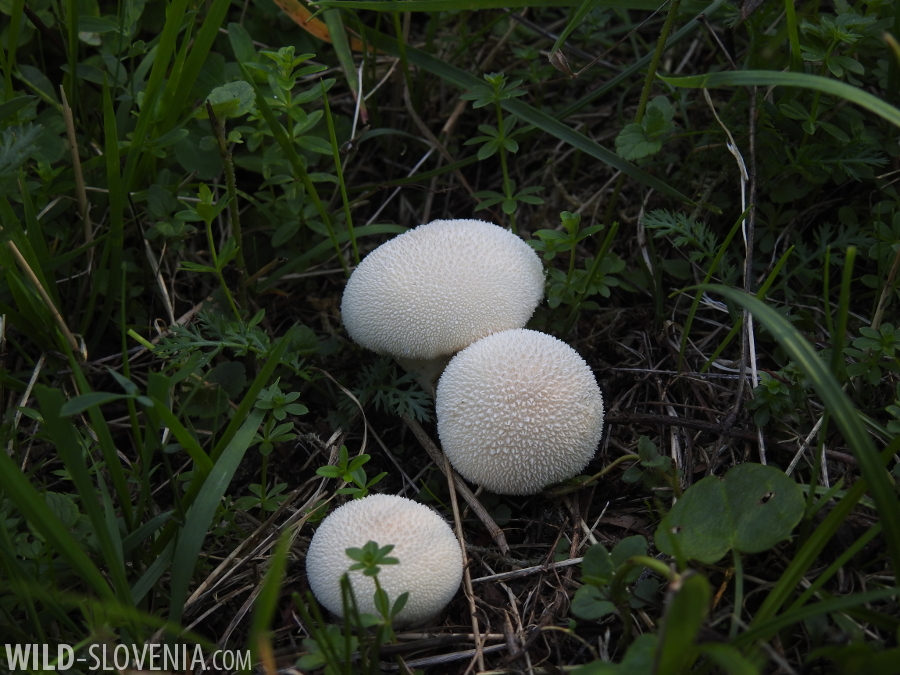
Common Puffball Lycoperdon perlatum
Autumn Crocus Colchicum autumnale
Willow Gentian Gentiana asclepiadea
Fringed Gentian Gentianella (Gentianopsis) ciliata