Thursday, 6 December 2018

Lake Cerknica and its forests

The temporary lake of Cerknica is always worth a visit, even in a relatively calm season like late autumn. A few days ago we headed to the lake area, hoping to catch up with some good birds, including perhaps the odd migrant Common Crane. The lake was full of water and held quite a lot of birds too. First of all there was an adult White-tailed Eagle Haliaeetus albicilla perched on a pole at the lake's shore. Then we checked the wildfowl and spotted some interesting wintering birds like the first Goldeneyes Bucephala clangula of the season (7 in total), 2 Ferruginous Ducks Aythya nyroca and the commoner Pochards Aythya ferina, Tufted Ducks Aythya fuligula and Wigeon Anas penelope. Interesting was also the presence of 40 Shelducks Tadorna tadorna (a rather scarce bird inland) and 7 Black-necked Grebes Podiceps nigricollis. 

White-tailed Eagle Haliaeetus albicilla


Then some loud and very distinctive calls alerted us to the presence of a flock of Common Cranes Grus grus passing overhead. On such a beautiful sunny day, they were migrating straight overhead to the west, but passed relatively low above the lake. We were very happy to see them indeed, as these were our first (and only?) cranes of the autumn passage this year. Even this year large numbers passed above our region in late November.

Common Crane Grus grus - with mount Triglav (Slovenia's highest peak) as a backdrop!


Minutes later we heard again some loud calls in the sky, but these belonged to White-fronted Geese Anser albifrons. A flock of around 80 birds was migrating westwards, probably to the farmland and wetlands of northeastern Italy, where large flocks are already present. Actually a wintering flock of at least 3000 White-fronts, present at Isola della Cona Nature Reserve near Gorizia, hosts also a Red-breasted Goose Branta ruficollis and a Lesser White-fronted Goose Anser erythropus. We didn't go to look for these rare geese yet, but we migth give them a try in the coming weeks. 

White-fronted Goose Anser albifrons
Lake Cerknica with mount Slivnica dominating above it.
Mount Triglav (2864 m) in the distance - about 80 km away from lake Cerknica.


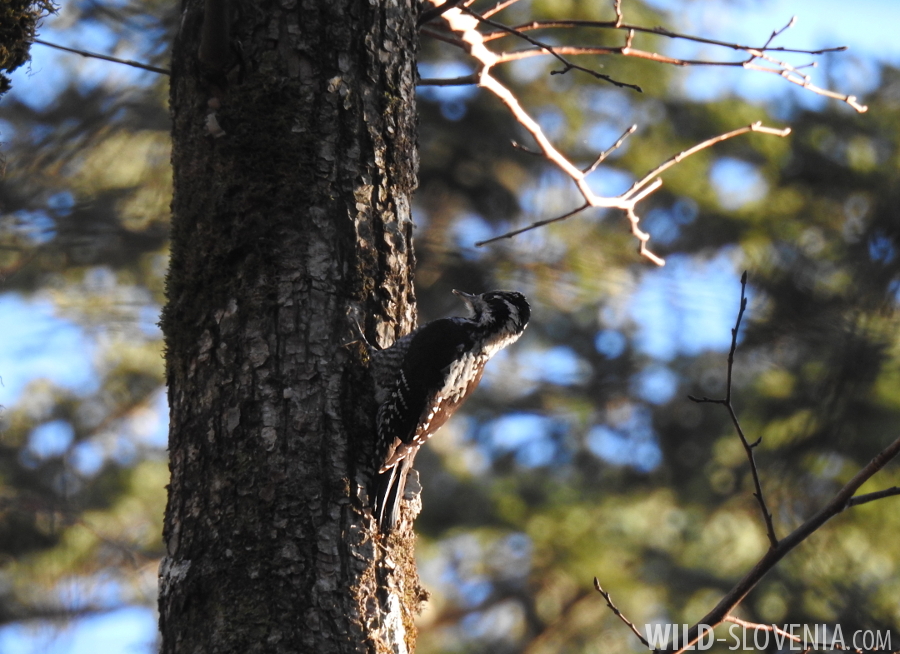
After spending the morning around the lake, we simply couldn't resist to the call of the forest and so we were soon driving on the forest tracks of the Javorniki-Snežnik mountains. We wanted to spend some time looking for a Three-toed Woodpecker and that's exactly how most of the afternoon was spent. Finding a Three-toed Woodpecker usually requires some walking up very steep and rocky forest terrain, where the species likes to hide itself, in old and undisturbed conifer stands. The usual giveaway of the presence of this rare woodpecker is the characteristic tapping on trees that the bird does when it feeds. When you hear it, you simply need to follow the sound. The problem is there are Great Spotted Woodpeckers Dendrocopos major too around and distinguishing the different tappings isn't always easy. A general rule applies here: if the bird insists with its tapping when you approach, then it's probably a Three-toed, while if the bird flies away it's probably a shy Great Spot. Three-toed Woodpeckers aren't shy at all and when feeding they usually allow very good and close views. After an exhausting hike uphill, following one such "good" sound, we were finally putting our eyes on a fantastic male Three-toed Woodpecker Picoides tridactylus! Nearby was also a female and the two birds (a pair we actually already observed in the same area) were frequently feed together on large wind-fallen silver firs. We stayed with them and enjoyed in the constant sound of "knocking" for more than an hour. Despite this, we didn't manage to take any good photos, but we were very happy nevertheless. We then rounded up the day with a Ural Owl Strix uralensis that we flushed from the side of the road, as we were driving back home in the evening.

Three-toed Woodpecker Picoides tridactylus - male.
Three-toed Woodpecker Picoides tridactylus - pair feeding on the same tree!


Earlier last week we made one or two brief walks in the karstic woodlands near Sežana and observed a pair of Middle Spotted Woodpeckers Dendrocopos medius, as well as a flock of more than 40 Redwings Turdus iliacus, feeding in the leaf litter and on ivy berries in the trees.

MIddle Spotted Woodpecker Dendrocopos medius
Redwing Turdus iliacus


Friday, 30 November 2018

Garden birds in the Karst

Hawfinch Coccothraustes coccothraustes
Brambling Fringilla montifringilla (female above and male below).
Goldfinch Carduelis carduelis
Rock Bunting Emberiza cia
Greenfinch Chloris chloris, Hawfinch Coccothraustes coccothraustes and House Sparrow Passer domesticus.

November has always been a quite depressing and slow month for wildlife watching. Days are becoming incredibly short, outside is cold or wet and there's a certain lethargic feel in the air, an impulse for going into hibernation. These days almost the only regular birding we do is from our bedroom's window onto the birdfeeder in our karstic garden. The situation is quite lovely actually. Species like Hawfinch Coccothraustes coccothraustes (up to 3), Greenfinch Chloris chloris (up to 5) and Goldfinch Carduelis carduelis (3-4) are present almost non-stop on the feeder, as are good numbers of Blue Cyanistes caeruleus & Great Tits Parus major, an occasional Marsh Tit Poecile palustris, Robin Erithacus rubecula and House Passer domesticus & Tree Sparrows Passer montanus. When the weather gets colder small numbers of Bramblings Fringilla montifringilla appear too. One of the most exciting recent encounters was with a flock of Rock Buntings Emberiza cia that came feeding in the cabbage patch in our vegetable garden. These birds are typical for the Karst and are quite abundant in western Slovenia on rocky slopes, screes and along limestone cliffs. As they like to feed on bare ground they sometimes visit large gardens and orchards in winter in search of small seeds. So far we've been lucky to have them a couple of times, so maybe they'll return.

Monday, 19 November 2018

Greater Spotted Eagle in Istria

Yesterday we tried to escape from the strong and cold northeasterly wind (called burja), currently sweeping over most of western Slovenia and making outdoor activities quite unpleasant. With a group of friends we set for the warmer Istrian peninsula, in nearby Croatia, just about 15 km away from Slovenia's southern border. We visited the Mirna river valley in the hope of catching up with some interesting wintering birds, including an immature Greater Spotted Eagle Aquila clanga (or Clanga clanga) which has been reported at least a week or so ago. We were quite lucky with the eagle as it was one of the first birds we saw when we arrived. It was perched on a tree along the river Mirna, quite close to the river's estuary. It showed well, both perched, flying and hunting, but usually from a distance. Although we don't know the status of this species in Croatia, it is probably similar to the status in Slovenia, being a rare an irregular winter visitor. There have been records of overwintering birds in Slovenia, but not very recently. In the north-east of Italy the species is a more or less regular wintering bird, with small numbers in the lowlands of the river Po. This year there seems to be a small "invasion" going on with several birds reported in various central and southern European countries in November. Some observers stated that they actually saw two different Greater Spotted Eagles on the river Mirna, however we only saw one. Moreover the area seems to be the wintering ground of a Golden Eagle Aquila chrysaetos, that has also been reported recently.
Some other interesting birds we observed in the Mirna valley included an unexpected drake Mandarin Duck Aix galericulata (unknown origin), a female Hen Harrier Circus cyaneus, a Peregrine Falco peregrinus, a Great Grey Shrike Lanius excubitor and some common waterbirds. 
On our way back we stopped at the Karst edge in SW Slovenia where on the limestone cliffs we observed our first Wallcreeper Tichodroma muraria of the winter season. More on this species hopefully in one of the next posts.

Friday, 9 November 2018

Cerknica lake, Snežnik & Karst

The colourful autumn season in the Dinaric mountains is coming to an end and is giving way to the overall grey and dull atmosphere of late autumn. Lower down, in the oak & beech woodlands of the Karst of western Slovenia, the situation is still slightly better as the season proceeds more slowly and the colour spectacle is in full swing at the moment.
Last weekend we took a couple of friends out birding on lake Cerknica and in the Snežnik forests. The temporary lake was finally a proper lake full of water (after several months of drought). The recent abundant rainfalls enlarged the local streams and made karstic springs burst with water. The typical karstic "polje" (flat fields with karstic springs) have now turned into lakes. Despite all the water, the lake was quite poor with birds. Nevertheless the situation was quite lively in the woodlands, open meadows and small villages around the lake. Among the most interesting birds was a male Merlin Falco columbarius sitting on a distant bush, a pair of Hen Harriers Circus cyaneus, a Great Grey Shrike Lanius excubitor and nice noisy groups of "autumn passerines" including Redwing Turdus iliacus, Brambling Fringilla montifringilla, Siskin Carduelis spinus, Crossbill Loxia curvirostra, Bullfinch Pyrrhula pyrrhula, Hawfinch Coccothraustes coccotharustes and quite a lot of Mistle Thrushes Turdus viscivorus, defending their mistletoes. Among proper waterbirds were just some small numbers of common wildfowl, Water Rail Rallus aquaticus and Kingfisher Alcedo atthis.
Lake Cerknica from its northwesternmost side.
Kingfisher Alcedo atthis

After checking the lake we retreated into the Dinaric forests of the Javorniki and Snežnik mountain chain. These proved of course very interesting, as usual. While driving on one of the many forest roads we spotted the characteristic dark shape of a Ural Owl Strix uralensis, perched at mid height in some trees a few meters away from the road. As it frequently happens with birds like these, the individual was in hunting mode and completely immersed in its duties. We stopped the car and watched it for about 15 minutes, before it decided to fly off, deeper into the forest. On closer inspection we realised it was a grey-morphed female from a local pair we already knew and which we observed several times, a few hundred meters away along the same road. In the photos below note the dark barring on the facial mask (not pure-white) - a typical feature of a grey-morph individual.
Ural Owl Strix uralensis
Watching and phone-scoping the Ural Owl.

During another stop along the same road, we happened to park the car right under a spruce with a woodpecker in action. We could only hear the bird flapping its wings as it flew away from us, but as it landed on another distant tree, we were absolutely excited as we put our bins on it: a male Three-toed Woodpecker Picoides tridactylus. It remained in view for only about a minute or so, but we nevertheless managed to get in in the scope and have excellent views.
Three-toed Woodpecker Picoides tridactylus

Other woodpeckers were also available in the form of 2-3 Black Woodpeckers Dryocopus martius (heard only) and 2 Grey-headed Woodpeckers Picus canus (1 seen), while in the evening we also heard a distant Pygmy Owl Glaucidium passerinum making its distinctive "autumn call".
As it can frequently happen in these forests, the final surprise comes right at the end of the day. As we were driving back home through a forest road in the Javorniki mountains, we were fortunate to see a Brown Bear Ursus arctos. If it wasn't for Sara, who spotted the young bear from the back seat of the car, we would have certainly missed it! The bear was some 5 meters away from the road, on a rocky slope and even rose on its rear legs to inspect the surroundings. After checking us calmly it slowly (but still too quickly for taking any photos!) disappeared into the vegetation. It was the most perfect ending to a long day's birding in Notranjska!
In the forest we also found some fresh fungi, all new after the recent rainfalls; below are some of the most interesting.
Common Stinkhorn Phallus impudicus
Yellow Brain or Golden Jelly Fungus Tremella mesenterica
Probable Dacrymyces sp.
"Fir Coral Tooth Fungus" Hericium alpestre - same specimen as in this post, but better looking a month later!
Lobaria pulmonaria (a lichen, not a fungus)

Meanwhile in the warmer Karst of western Slovenia the forest streams in the flysch (mudstone) hills are also full of water and the leaf litter is completely sodden. During a few short walks near Sežana we observed several Fire Salamanders Salamandra salamandra wandering about the forest floor. These interesting amphibians are widespread in Slovenia and live in woodlands, never far from a nearby source of water (stream, pond...). They are strictly nocturnal, but can be seen roaming around at daytime after rainfalls or when the forest is wet enough. This is the pefect time of the year to spot one - during 3 recent visits we observed at least 6 different specimens.
Fire Salamander Salamandra salamandra
Fire Salamander's typical habitat.
Autumn in the beech-oak woodlands in the Karst.
Porcelain Fungus Oudemansiella mucida

With all the recent wet and rainy weather the temperatures kept unusually warm for the season. Thus we are still seeing quite a lot of butterflies on a daily basis. Species such as Red Admiral Vanessa atalanta, Brimstone Gonepteryx rhamni, Speckled Wood Pararge aegeria and Small Copper Lycaena phleas are pretty usual at this time of the year, as well as the odd Hummingbird Hawk-moth Macroglossum stellatarum. However yesterday we were quite amazed to see a Nettle-tree Butterfly Libythea celtis at a woodland's edge in Sežana. This small butterfly, linked to the Nettle-tree Celtis australis for the development of its larvae, is a migrant and thus can be regularly found in unusual places, away from its food plant. In Slovenia the species is present mostly in the warmer western part of the country. Certainly the last decend butterfly we see this year!
Nettle-tree Butterfly Libythea celtis

Thursday, 8 November 2018

BIRDING IN SLOVENIA - WildSlovenia's new page

Recently we updated our website and included a new page - Birding in Slovenia, which gives an overview about the bird species diversity of Slovenia. It also includes a selection of the best birding sites in the country and a phenological check-list of the most interesting species. Hopefully it will help visiting birders with the basic info about our birdlife. You're welcome to take a look inside!