Thursday, 31 December 2015

2015 HIGHLIGHTS

 2015 has come to an end, so it's time for the yearly review of my field activity. The very best moments of my 2015 are represented in the images below. As this was a "botanical year" for me, I'll start with my top 4 plant highlights; birds and other wildlife follow (not in chronological order).

 
  Eryngium alpinum - Porezen (Julian Prealps), July.

Cypripedium calceolus - Snežnik plateau, June.

Scopolia carniolica - Kočevje forest, April.

Physoplexis comosa - Mangrt (Julian Alps), July.


Birds/animals:
Tengmalm's Owl Aegolius funereus - Trnovski gozd, November. A sketch from the notebook. This was my best bird sighting of the year (first time I saw one so well).

 
In 2015 I was lucky enough to see two different Brown Bears Ursus arctos while driving on forest roads in Slovenia. The first was in October on the Snežnik plateau, while the second was in December in Trnovski gozd. The latter was observed well for a prolonged time and rates as one of the best observations of the year (pic taken last year in the Kočevje forest complex).

Rock Thrush Monticola saxatilis - Nanos, May. An excellent present for my birthday, accompanied by a variety of mountain flowers and nice sunshine.

 
Red-breasted Flycatcher Ficedula parva - Alps in northern Slovenia, June. A bird that I really wanted to see on its breeding grounds in Slovenia. Had two birds singing close by in a mountain beech forest.


Wallcreeper Tichodroma muraria - Trieste, April. The first observation of this species in my local patch and it was even a summer-plumaged male.

White-backed Woodpecker Dendrocopos leucotos - Kočevje, April. The other few White-backs I had this year were also in the Kočevje forests and on Snežnik.

Three-toed Woodpecker Picoides tridactylus (male) - Javorniki mountains, December. This year I managed to see at least two males, while females were more commonly encountered (as in 2014). All observations were made in the Dinaric forests of Trnovski gozd, Snežnik, Javorniki and Kočevje.

 
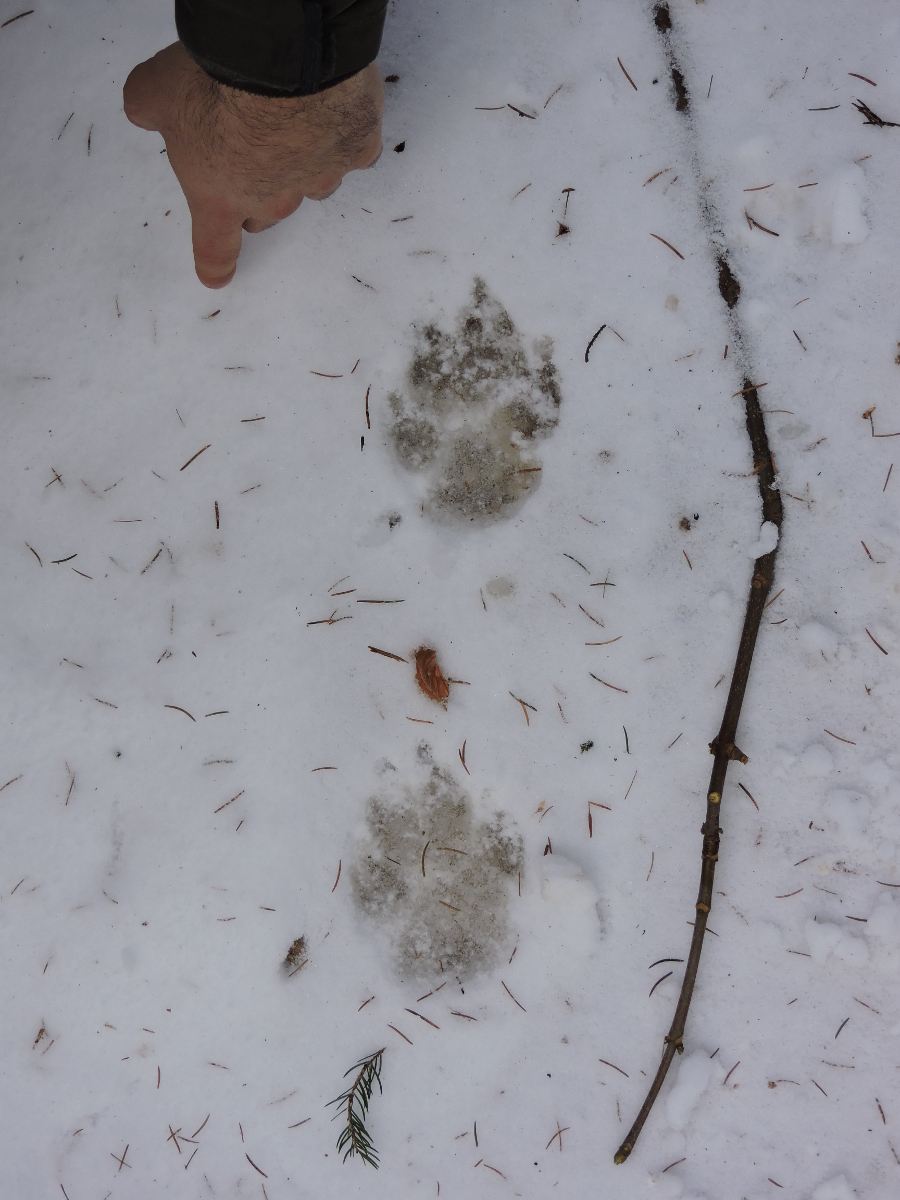
During an organised census in August, I heard my first Grey Wolf Canis lupus, howling at the moon on the Slovenian Karst. The above picture shows some probable wolf tracks in the snow on Javorniki mountains (December).

Syrian Woodpecker Dendrocopos syriacus - Illmitz (Autsria), October. With this species I completed the mission of seeing all european Picids in one year! Apart from the above, all the others were in Slovenia. Highlights of the autumn trip to Austria included also Imperial Eagle Aquila heliaca, Saker Falco cherrug, Red Kite Milvus milvus and others.

 Middle Spotted Woodpecker Dendrocopos medius - Slovenian Karst, January. In 2015 I found some new locations on the Karst, where this species breeds rarely. At least 4-5 different birds were seen. 

Ural Owl Strix uralensis - Kočevje, May. I had several encounters with this species through the year, especially in spring. The most interesting was the record of a probable breeding pair, I found and followed on the Slovenian Karst.

Pygmy Owl Glaucidium passerinum - first pic from the Pokljuka plateau, second from Trnovski gozd (both in November). Showing beautifully on sunny autumn days.

Snowfinch Montifringilla nivalis - Mangrtsko sedlo (Julian Alps), August. A pair was feeding its young on a vertical cliff. Not very easy to catch up with this high-altitude species.

Collared Flycatcher Ficedula albicollis - Krakovski gozd, May. One of the many (+10) holding territory in the alluvial forest on a warm spring day.

White-tailed Eagle Haliaeetus albicilla (adult) with a Buzzard Buteo buteo - Krakovski gozd, May.

Black-winged Kite Elanus caeruleus - Pordenone (Norh-east Italy), February. A bird I went to twitch with a couple of friends. It was present there for quite some time, but was always distant and flighty.

Red-footed Falcon Falco vespertinus - Slovenian Karst near Sežana, May. This year we had an invasion of this species, with hundreds of birds reported daily from different parts of Slovenia. The above picture shows a small part of the +80 individuals I saw on my location.

Black Stork Ciconia nigra - Cerkniško jezero, June. While watching this bird I also had several singing Rosefinches Carpodacus erythrinus on the wet grasslands around the Cerknica lake.

A glorious September day on mount Vremščica (looking north towards Triglav) where after 4 years I saw again a Dotterel Charadrius morinellus on migration.

Bearded Tits Panurus biarmicus - undisclosed site in north-east Italy, December. 


Botanical lifers or wish-to-see species:
Fritillaria meleagris - Ljubljansko barje, March.

Pedicularis friderici-augusti - Slavnik, May.

Himantoglossum adriaticum - Bertoki (Koper), May.

Scilla litardierei - Planinsko polje, June.

Nigritella lithopolitanica - Velika Planina (Kamniško-Savinjske Alpe), June. 

Nigritella rubra (N. miniata) - Mangrtsko sedlo (Julian Alps), July.

Dianthus sternbergii - Mangrtsko sedlo (Julian Alps), July.

Campanula zoysii - Mangrtsko sedlo (Julian Alps), July.

Gentiana pannonica - Porezen (Julian Prealps), July.

Geranium argenteum - Krn (Julian Alps), August.

Papaver alpinum ssp. victoris - Krn (Julian Alps), August.

Spiranthes spiralis - Trieste Karst (North-east Italy), September.

Viola zoysii - Stol (Karavanke), December.


Other wildlife:
Horn-nosed Viper Vipera ammodytes - Carsiana botanical garden (Trieste), September. Up to 3 different individuals were regularly seen in a rocky area of the garden.

Rosalia alpina - Komna (Julian Alps), July.

Apollo Parnassius apollo on Carduus defloratus - Breginjski Stol (Julian Alps), July.

 Adder Vipera berus - Črna prst (Julian Alps), July.

Alpine Ibex Capra ibex - Krn (Julian Alps), August.


Best places I've been to:
Sunrise from mount Krn (Julian Alps) in August.

  Beech forest on mount Nanos with a carpet of Wild garlic Allium ursinum; May.

Črna prst (Julian Alps) - a mountain of botanical delights; July.


South-western grassy slopes of Nanos with Lilium carniolicum and lots of other flowers; June.

Snežnik - mountain & forest; June.


Wet grassland at Cerkniško jezero with Eriophorum angustifolium; June.

Soča river in the Trenta valley (Triglav National Park); August.

 Still discovering new hidden places in Trnovski gozd; November.

Mount Triglav from Šijec bog on the Pokljuka plateau; November.

Monday, 28 December 2015

Karavanke with Viola zoysii

Viola zoysii (Zois' violet) - historically found and described in Slovenia, in the Karavanke mountains. A typical species of this mountain chain, with a disjunctive population in the Balkans. Surprisingly in bloom at the end of December!
The village of Zasip near Bled and mount Stol in the background.
Mali Stol (right) and Veliki Stol (left).
Helleborus niger - in full bloom on the forest floor.
Alpine Chamois Rupicapra rupicapra on a steep slope.
View on mount Triglav (Slovenia's highest peak).
Mist and fog in the valley, looking towards Ljubljana.
Rocky landscape near Stol's summit.
View eastwards from the top of Stol.
Alpine Choughs Pyrrhocorax graculus looking for bread crumbs.
Dipper Cinclus cinclus
Goosander Mergus merganser

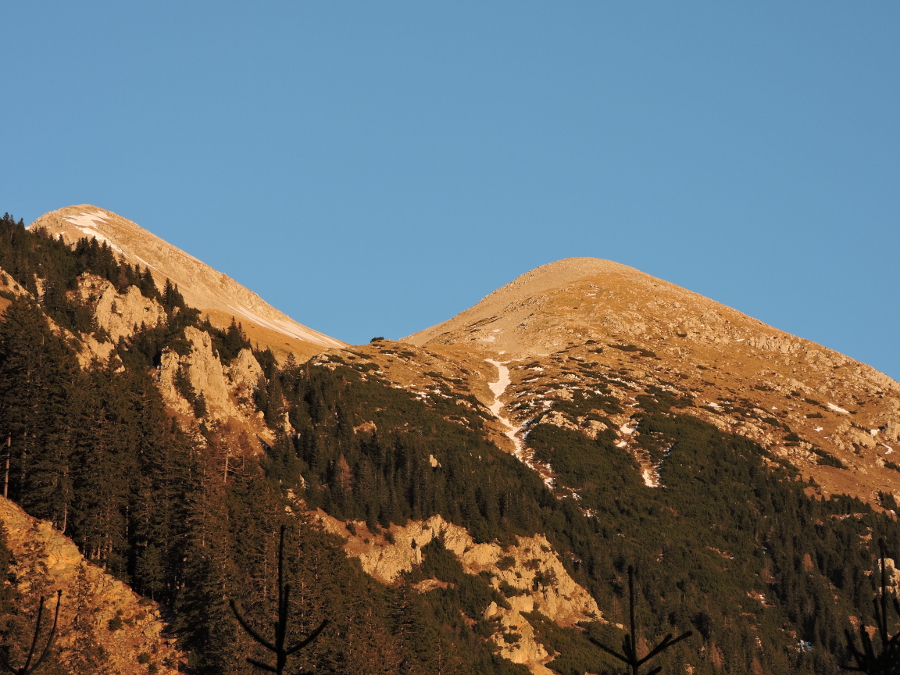
Back from two sunny days in the mountains. This time was the turn of mount Stol ("Hochstuhl" in German) which is the highest peak in the Karavanke (Karawanken) mountain range; its summit reaches 2236 metres. The mountain chain divides Slovenia (south) and Austria (north).
It was very warm for the season with very little snow on the ground. Most of the walk up to this mountain was greeted by the bloomings of Helleborus niger, Erica carnea, Primula vulgaris and Hepatica nobilis. All in flower a few months earlier than usual.
But the most unusual and unexpected find was that of some specimen of Viola zoysii in flower on Stol's summit. This plant usually blooms in summer, but most interestingly, it is a true specialty of Karavanke. It was discovered right here around 1785 by Karel Zois and later named after him. In Slovenia it is only found in the Karavanke mountains.
This taxon has an interesting distribution. In Slovenia it reaches the north-western edge of the range, whereas the rest of the global population is disjunctive in the western Balkans (Croatia, Montenegro, Bosnia, Kosovo, Macedonia, Albania). A typical and didactic example in biogeography.

The walk on Stol was also enlivened by Alpine Chamois Rupicapra rupicapra on the steep grassy slopes and a noisy flock of Alpine Chough Pyrrhocorax graculus. Down in the valley, the river Radovna produced a few Dippers Cinclus cinclus, while the lake of Trboje held a group of at least 17 Goosanders Mergus merganser and the first Goldeneyes Bucephala clangula of the season.

Monday, 21 December 2015

Wallcreeper


Wallcreeper Tichodroma muraria is a regular winter visitor to the Karst and western Slovenia. It usually prefers sunny limestone cliffs where it can find small invertebrate prey even in the middle of winter. Compared to the summer time, when Wallcreepers are difficult to see on their breeding grounds in the Alps, in winter they are relatively easy to find and observe. The prime wintering area is the Karst edge, which is dominated by vertical cliffs and extends from Slovenia into Italy, stretching above the town of Trieste. Some days ago I saw the above bird in the Glinščica/Val Rosandra nature reserve, just a few kilometres away from Trieste (photos by Sara Cernich; the video can be viewed in better resolution here).
For more posts about the species:
Wallcreeper in the patch
Wallcreeper and Alpine Accentor in the Glinščica valley
Wallcreeper memories 
More videos here and here.

Saturday, 12 December 2015

Brown Bear in Trnovski gozd!

Brown Bear Ursus arctos (Kočevje, 2014).
A view on some conifer stands in the heart of Trnovski gozd, W Slovenia.
Black Woodpecker Dryocopus martius - female. Video here (the call can be heard).
Black Woodpecker's artwork on a (still living) Norway spruce Picea abies. The largest holes were interconnected, so the base of the trunk was completely hollow! These long, oval holes (especially when seen in conifers) are a characteristic sign of Black Woodpecker's feeding.

Another day in the Trnovo forest (Trnovski gozd) that will be long remembered in my memory. Bird-wise it was calm, but the walk through the forest was brilliant...as it was the day's ending. In the evening, while driving back home, a BROWN BEAR Ursus arctos materialised on the forest road about 50 metres in front of the car! It walked away slowly, on the slope above the road, where it hid in a dense stand of young conifers. We approached and from the car we could hear it moving through the forest (heavy steps on the leaf-covered floor). Then with the aim of my small torch, we spotted it again and watched it for some more minutes as it slowly moved away from us. When we lost it, we turned off the torch and followed its movements through the forest by listening to the noisy steps, until it was far in the distance. A few seconds later, a look at the night sky revealed a shooting star. But there was no need to make a wish!
Brown Bears are known to inhabit Trnovski gozd, but in smaller numbers than in southern Slovenia. Slovenia's population is divided by the main motorway connecting the coast to Ljubljana and represents a barrier for migrant large carnivores. North of the motorway, although there is suitable habitat, densities are much lower than in the south (for more info about the species in Slovenia check this site). Seeing a Bear in Trnovski gozd was a truly special experience for me. Surely one of the highlights this place has to offer.

As I mentioned before, during the day, we only had a few common forest species like Willow Poecie montanus and Crested Tits Lophophanes cristatus, Treecreeper Certhia familiaris, Black Woodpecker Dryocopus martius ect. The most interesting was a Tengmalm's Owl Aegolius funereus calling in the evening. But at the moment the birdlife in these upland forests is becoming pretty scarce due to the incoming winter period.


I'm glad to announce I have a new addition to my blog list - Birding Ljubljansko barje - a diary from a team of young birders, who concentrate on the Ljubljana marsh, on the outskirts of Slovenia's capital city. You also find the link on the Blog List bar to the right. Have a look!

Tuesday, 1 December 2015

Three-toed Woodpecker - male!

On Sunday I found myself roving in the forests around Cerkniško jezero (Javorniki mountains precisely) with a couple of friends. We had a nice walk in the snow and in a stand of dead conifers found a stunning male Three-toed Woodpecker Picoides tridactylus, intensively feeding and allowing great views as usual (above; last photo by S. Cernich). Two short videos can be found here and here (watch at 720p). Being a male and set in a nice snow-covered forest with a warm sunshine, this was, with no doubt my best ever Three-toed Woodpecker!
Conifer forest on Javorniki with the season's first layer of snow (10-20 cm).
Javorniki mountains from Cerkniško jezero. The highest point, Veliki Javornik is 1268 metres high.
By the Cerknica lake (Cerkniško jezero), in a small woodland, we unexpectedly came across this nice Middle Spotted Woodpecker Dendrocopos medius, which I've seen only once before in the area. In addition we also had Grey-headed Picus canus and Black Woodpecker Dryocopus martius.
Fieldfares Turdus pilaris were common in the villages around Cerkniško jezero. The lake itself was partly dry and didn't produce many birds. Just a few ducks in the form of Wigeon Anas penelope, Gadwall A. strepera and Tufted Duck A. fuligula.
In the forest we also came across these tracks which could possibly be of Grey Wolf Canis lupus. The linearity of the tracks over several hundred metres of path, the paw size and the absence of human tracks nearby (all excluding domestic dog) suggest our hypothesis.

Friday, 27 November 2015

Dippers

Only a Dipper Cinclus cinclus could fancy a plunge in a cold stream in these freezing conditions. The weather has been quite wintry in the last week or so, with strong and cold northeasterly winds (locally known as burja/bora). The first snow has fallen over most of Slovenia and it still persists on the higher altitudes. Also some parts of the higher Karst are still white at the moment.
Today I was in Postojna where I visited the Karst Museum (which I strongly recommend) and on the river Unica I saw 3 showy Dippers. As usual quite funny-looking and full of character as they dive and try to fight the current. On this link a (bad quality) video, filmed from inside the car, in which you can hear Status Quo playing on the radio!
Other notable observations that enlivened my week included the first two Slavonian Grebes Podiceps auritus and Black-throated Divers Gavia arctica of the winter (on the sea near Monfalcone, north-east Italy), a passage Redwing Turdus iliacus on the Karst and a distant howl from a Golden Jackal Canis aureus on the Italy/Slovenia border near Gorizia/Gorica. My first jackal actually.

Wednesday, 18 November 2015

Flamingos & lowland owls

Flamingos Phoenicopterus roseus - small part of a flock of +900 birds!
Water Rail Rallus aquaticus
Birding from a hide...sometimes.
Black Woodpecker Dryocopus martius - an artistic shot taken on the Karst recently.

From time to time I visit the coastal wetlands in north-eastern Italy, not far from Trieste. On Saturday I guided a trip there and visited Isola della Cona, Valle Cavanata and areas near Grado. The main attraction was a large flock of FLAMINGOS Phoenicopterus roseus present in the pools of Valle Cavanata. Other observers in the previous days counted at least 900 individuals so this was certainly the biggest flock of Flamingos I've ever seen. The species is becoming increasingly regular in larger numbers at this wetland site and it is colonising the lagoons near Grado and Marano, spreading from its nearest nesting grounds close to Venice. I was also impressed by the large number of Pygmy Cormorants Phalacrocorax pygmeus in Valle Cavanata - about 30 or more. A showy Water Rail Rallus aquaticus was also performing very well in front of the hide (above), so the group was quite happy.
After enjoying a nice variety of wetland birds between Valle Cavanata and Isola della Cona, in the afternoon we visited a day-time roost of Long-eared Owls Asio otus, where 4 birds were taking a nap on a pine. We waited dusk nearby and were rewarded first with a Little Owl Athene noctua perched on a pole and later with a gorgeous BARN OWL Tyto alba sitting on a window sill in the ruins of an old farm. Instead of a photo, here's an old Barn Owl video I uploaded on my Youtube page recently.