Wednesday, 7 April 2021

Chasing White-backs & Middle Spots

Although Slovenia is now in the middle of a very cold and snowy front (more about that at the end of the post), the past weeks have been surprisingly sunny and warm, allowing extensive woodpecker surveying sessions. Domen has been busy searching for breeding White-backed Woodpeckers Dendrocopos leucostos ssp. lilfordi in the wildest and most forgotten corners of the Snežnik plateau. Some of these areas support large quantities of dead beech wood which is full of signs (feeding, nesting...) of this rare woodpecker, however locating and following the birds is rather challenging, given the extremely "varied" terrain. White-backed's favourite habitats are located in areas of old beech forests in extremely rocky and rugged terrains, full of dolinas (sinkholes), steep ridges and depressions, where forestry activity has been rendered difficult or impossible. At this time of year there's still a considerable amount of snow which in some places complicates the matter even more. If at the beginning of March Brown Bears Ursus arctos were probably not out of the dens yet, now the situation is clearly different. Their footprints in the snow are everywhere (including those of mum bears with newly born cubs) and they even outnumber those of the omnipresent Red Deer Cervus elaphus. Here and there you can also find the occasional footprint of Wolf Canis lupus.
Brown Bear's tracks in the forests of Snežnik.
Mama Bear and this year's cub.
Adult Brown Bear Ursus arctos.
Footprint of Wolf Canis lupus.
White-backed Woodpecker's habitat.
Fresh feeding signs of White-backed Woodpecker.
White-backs frequently feed on the ground on smaller pieces of rotten logs.
Freshly excavated nest-hole of White-backed Woodpecker.
 
There are certainly more signs that there are White-backed Woodpeckers! Despite a considerable surveying effort we were able to locate only a few individuals, although we didn't search an extensive area, but only part of a large forest reserve. With the kind help of friends we so far tracked down 3 different territories of White-backs, although we didn't locate any active nest-holes yet. The breeding activity seemed a bit slow and only occasionally the woodpeckers were drumming. It was however interesting to watch these rare birds feeding on the ground on small pieces of rotting wood. In the selection below is a female that showed particularly well and allowed us to record a decent video. Note the large white grubs she digs out on two occasions in the video - these represent the species' most important food source.

Female White-backed Woodpecker Dendrocopos leucotos ssp. lilfordi feeding on a rotten beech log.


Other birds in the forest are showing more prominent signs of breeding like Nuthatches Sitta europaea that we observed nest-building on several occasions. One of them was adapting an old White-backed Woodpecker's nest-hole in a standing dead beech. Otherwise Tawny Strix aluco and Ural Owls Strix uralensis are very vocal and several individuals of each are usually heard during our fieldwork, even in the middle of the day. Owls this year probably don't need to put much effort into hunting as the forest floor is still teeming with large numbers of Bank Voles Myodes glareolus. During one of our last trips we were also very lucky to find a freshly shed and amazingly big Red Deer's antler - something you certainly don't come across every day, especially if you don't go specifically looking for it.

Freshly shed antler of Red Deer Cervus elaphus.
How to make a very happy boy!
Christmas Rose Helleborus niger
Brimstone Gonepteryx rhamni on White Crocus Crocus vernus ssp. albiflorus.
But winter has won... for now.
Comma Polygonia c-album
The dry stony grasslands on the south-western edge of Snežnik's plateau.
 
 
Back in March we also went to check some rather unlikely White-backed Woodpecker's territories in the commercial forests of Javorniki, where, despite extensive logging in the area, a pair was found drumming intensively at sunrise (a clear sign of breeding). Sadly such scenes of intensive logging as depicted below are an increasingly common feature across Slovenian forests, regardless of the area or region. 
Heavy logging in a commercial forest where White-backed Woodpecker breeds.

White-backed Woodpecker Dendrocopos leucotos ssp. lilfordi, male & female territorial drumming.


Meanwhile Sara has been extensively surveying Middle Spotted Woodpeckers Leiopicus medius and parameters of their nesting habitat in the Karst's oak forests. So far she recorded up to 29 territorial Middle Spots, mostly in the known areas of mature oak stands where we've been studying the species over the past years. The species seems to be doing well in western Slovenia, continuing its range expansion westwards and being also discovered at new sites, which were previously "empty". Censuses in the last week were particularly pleasing as, apart from woodpeckers, the supporting cast in the woodland and nearby meadows also included the amazing spring chorus of singing Hoopoes Upupa epops, Cuckoos Cuculus canorus and Wrynecks Jynx torquilla that have all just returned from Africa. During a forest birds transect census we also met with our local Ural Owl Strix uralensis (calmly napping as usual), as well as with a pair of Black Woodpeckers Dryocopus martius excavating a new nest-hole.

Middle Spotted Woodpecker Leiopicus medius
Habitat of Middle Spotted Woodpecker in the Karst, with predominant species including Quercus petraea & Quercus cerris.
Hoopoe Upupa epops - male singing
 
Can you see it?
The unmistakable shape of a...
...sleepy Ural Owl Strix uralensis
Black Woodpecker Dryocopus martius (male), sunbathing in the second pic.

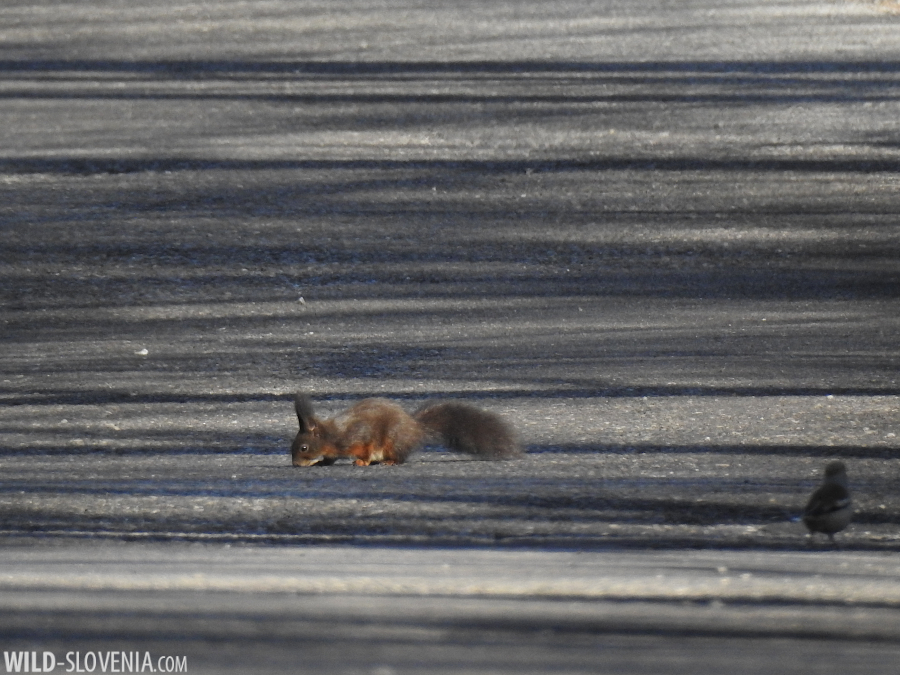
Red Squirrel Sciurus vulgaris licking the asphalt in the company of a Hawfinch Coccothraustes coccothraustes.
Common Toads Bufo bufo in amplexus, trying to cross a forest road.
Spring Heath Erica carnea
Dog's-tooth Violet Erythronium dens-canis
Hacquetia Hacquetia epipactis
Peacock Aglais io
Mountain Pasqueflower Pulsatilla montana, an attractive and rather common plant of dry karstic grasslands.
 
 
As we mentioned in the introduction, at the time of writing we are in the middle of an extremely cold front that on the 6th of April brought heavy snowfalls over much of Slovenia, including the Karst where we live. Hoping the weather will get warmer as soon as possible (think about all the insectivorous spring migrants, plants ect!), we round up the post with these unusual scenes from the woodlands around our home...
The final clash between winter and spring.

Sunday, 4 April 2021

Spring migrants

Spring migration has really kicked in and on Saturday 3rd April we had an exceptional morning at Škocjanski zatok Nature Reserve. This was mostly due to overnight precipitations, combined with a strong north-easterly wind that forced migrants to stop. The reserve's weekly monitoring took much longer than usual, but produced some truly good species for the area. Among the many newly arrived waders there were two showy Jack Snipes Lymnocryptes minimus (a rare sight), feeding in the wet meadows with about 35 Snipes Gallinago gallinago and a mixed flock of 63 Black-winged Stilts Himantopus himantopus (largest count for the species at the reserve), 25 Ruffs Calidris pugnax, 11 Wood Sandpipers Tringa glareola and 11 Green Sandpipers Tringa ochropus. A lonely Black-tailed Godwit Limosa limosa was also around, but even more interesting was a flock of 51 Whimbrels Numenius phaeopus dropping down from the sky and into the lagoon. Not only is this the species' biggest count for Škocjanski zatok, but probably also for the whole of Slovenia. The species is usually seen migrating singly or in small numbers and larger flocks are quite exceptional. However Whimbrels regularly migrate over the northern Adriatic, also in larger flocks (personal observations above Trieste), but usually very high up in the sky and are therefore rarely detected. The brackish lagoon also produced 7 Avocets Recurvirostra avosetta, 3 Little Ringed Charadrius dubius and 5 Kentish Plovers Charadrius alexandrinus, a Lapwing Vanellus vanellus, 7 Common Redshanks Tringa totanus and the usual Curlews Numenius arquata, Greenshanks Tringa nebularia and Common Sandpiper Actitis hypoleucos.

Around 25 Garganeys Spatula querquedula were scattered around the marsh in smaller numbers and two Purple Herons Ardea purpurea were on show in the freshwater reedbed, where a pair usually breeds. The wetland was constantly quartered by 3 Marsh Harriers Circus aeruginosus, flushing all the waders on a regular basis. The meadows bordering the freshwater marsh were full of Yellow Wagtails Motacilla flava of different subspecies (feldegg, cinereocapilla and flava) and among them we were also excited to see the first Hoopoe Upupa epops of the season, while a Wryneck Jynx torquilla was in the hedge bordering the lagoon. Other spring migrants included 7 Wheatears Oenanthe oenanthe, 2 Tree Pipits Anthus trivialis, 1 Willow Warbler Phylloscopus trochilus, 3 Sedge Warblers Acrocephalus schoenobaenus and a surprisingly early Marsh Warbler Acrocephalus palustris mimicking all sorts of birds in the hedge by the path. In the sky there were mixed flocks of hirundines, mostly Swallows Hirundo rustica (135 ind.), a few House Martins Delichon urbicum and several Sand Martins Riparia riparia, while also the first 2 Common Swifts Apus apus of the season were around. All in all an excellent mix of spring migrants. For more regular updates about the latest sightings at Škocjanski zatok NR check here & here.

Jack Snipe Lymnocryptes minimus
Part of a flock of 51 Whimbrels Numenius phaeopus
Little Ringed Plover Charadrius dubius
Redshank Tringa totanus (with a metal ring).
Black-winged Stilt Himantopus himantopus
Purple Heron Ardea purpurea
Garganey Spatula querquedula
Green Sandpiper Tringa ochropus
Coot Fulica atra nest-building.
Hoopoe Upupa epops
Swallow Hirundo rustica
Wheatear Oenanthe oenanthe
 
 
In the past week or so the sunny and very warm weather with mild southeasterlies has brought spring migrants to the Karst as well. Although it's still early to talk about the real "spring explosion" (still pretty wintry up here), we already heard our first Cuckoo Cuculus canorus and Wrynecks Jynx torquilla, while others reported Hoopoes Upupa epops, Nightingales Luscinia megarhynchos and Scops Owls Otus scops. In a week or so these summer migrants should become more numerous and prominent. The main interest for us was following our local pair of Short-toed Eagles Circaetus gallicus returning to its traditional nesting site, not far from our home. Hopefully more migration to report in the next days. Stay tuned!

Short-toed Eagle Circaetus gallicus