Wednesday, 10 August 2016

Mount Krn - Alpine paradise

I spent the past two days hiking on mount Krn in the Julian Alps and in the nearby mountain range. Below follows a step by step report of the wildlife (with landscapes) encountered along the way. (Similar trip to Krn in this post).
Mount Krn (the left, whitish summit) is 2244 meters high. Here an initial view from the starting point - Planina Kuhinja (991 m).
Cirsium eriophorum & cow - both are very common at altitudes around 1000 m, on the mountain pastures.
Gentiana cruciata is another quite common flower on mountain pastures.
Aconitum angustifolium - an endemic species in the Krn-Bohinj mountain range and a few other localities in western Slovenia. Common and very prominent on Krn where it grows at almost all altitudes, from pastures to the very summit.
Two record shots of an Apollo Parnassius apollo - a rare butterfly found on sunny grassy slopes, where the larvae feed on Sedum album. The adult butterflies like purple and reddish-coloured flowers, hence they are frequently seen on Carduus & Cirsium species. Very mobile and quite restless in sunny weather - thus difficult to photograph.
The way up through some wonderful mountain flower meadows, full of butterflies.
Dianthus monspessulanus (D. hyssopifolius) is very common on the sunny, grassy slopes.
Steep grassy slopes of Krn, looking south-eastwards.
Rdeči rob in the distance. This is a characteristic reddish mountain, sticking out of the predominantly white-coloured limestone. One of the most interesting geological phenomena in the Julian Alps (and Slovenia).
Somewhere half way to the summit.
Griffon Vulture Gyps fulvus - frequently seen exploiting thermals above Krn's slopes. Saw up to 11 birds together, followed later by two superb Golden Eagles Aquila chrysaetos.
Clouded Apollo Parnassius mnemosyne - another record shot of a rare and restless butterfly.
Campanula scheuchzeri
Mountain meadows with Scabiosa lucida, Cirsium, Rumex, Hypericum and a lot more (Krn's summit visible in the back).
Scorzonera rosea
Scabiosa lucida
The first bunch of Geranium argenteum, one of Krn's most typical flowers. It is very common around the top of the mountain, where grassy meadows give way to rocky terrain.
 Nigritella rhellicani
Saxifraga squarrosa
Getting closer to the top!
Potentilla nitida starts to appear around 2000 m.a.s.l. and above, where the terrain gets rockier.
Mountain hut close to the summit.
View from one of the coolest benches in Slovenia - by Krn's mountain hut, looking down into the valley.
Conquered the summit - on the top of mount Krn!
Views toward mount Triglav (Slovenia's highest peak) and surrounding alpine landscape in the Triglav National Park - Goldhorn's kingdom.
Sunset from Krn's hut - a view over the mountains that border with Italy (Kanin mountain range).
Something completely different is the sunrise at 05.55 from Krn's summit, looking north-east. As usual, Triglav is the most prominent landmark.
Alpine Accentor Prunella collaris is a common bird around Krn's summit - saw different family parties of more that 20 birds. Also a few Alpine Choughs Pyrrhocorax graculus were around.
Even more interesting was the Snowfinch Montifringilla nivalis. I didn't really expect it, so I was very glad to see two of them on the summit.
View down to the Soča valley and Krn's mountain pastures (south-west slopes).
Potentilla nitida in full bloom.
Krn's rocky summit.
Phyteuma sieberi is quite common on the northern rocky slopes and screes.
 Saxifraga crustata
Achillea atrata - a counterpart of the commoner A. clavennae.
Krn's north-eastern slopes - a completely different world from the sunny grassy ridges sloping to the south. Here Marmots Marmota marmota are frequently heard alarming.
Cerastium carinthiacum/uniflorum
Mt. Vrh nad Peski & sheep.
Geranium argenteum in its full beauty. Entire sub-alpine grasslands are covered with this beautiful flower which has very characteristic silver-coloured leaves. In Slovenia it is rare and found mostly in the Krn mountain range (southernmost chain of the Julian Alps).
Dianthus sternbergii growing in swathes on rocky screes. 
Screes in the Vrh nad Peski valley.
Armeria alpina is a beautiful flower that gives colour to the white screes.
Papaver alpinum ssp. victoris - endemic poppy of the Krn-Bohinj mountains.
Aquilegia iulia - Slovenian endemic species. Once thought to be A. bertolonii (which is mostly distributed in the Western Alps of Italy) and now regarded as a separate species. It grows on rocky mountain meadows and screes in the southern Julian Alps, part of the Kamnik Alps and in Trnovski gozd (Trnovo forest).
Lužnica lake (Jezero v Lužnici) - one of the three alpine lakes around Krn.
Campanula zoysii - one of the most interesting alpine flowers at all. It is a very old, ice age relict, found in the Julian, Kamnik & Carnic Alps and Karavanke mountains, as well as in the northern edge of Trnovski gozd. Unlike other Campanula species, it has a distinctive conical "bell" with a very narrow opening. Its pollination strategy remains a mystery.
Potentilla clusiana
Aster alpinus
Aconitum angustifolium
The descend reveals Krn's grassy slopes from another prospective.
Quite steep descend on the slopes south-east from mount Krn.
Linum viscosum on the way back, at the edge of a mountain pasture.
Gentiana cruciata - once again down on the grassy plateau of Planina Kuhinja.
A last look at mount Krn from Planina Kuhinja. Goodbye!

Wednesday, 3 August 2016

Wild Snežnik

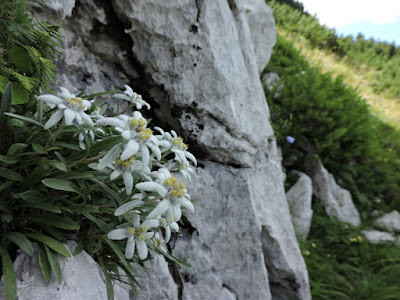
Leontopodium alpinum, Mt. Snežnik, 30th July 2016. 
The most typical alpine representative of Snežnik's flora.
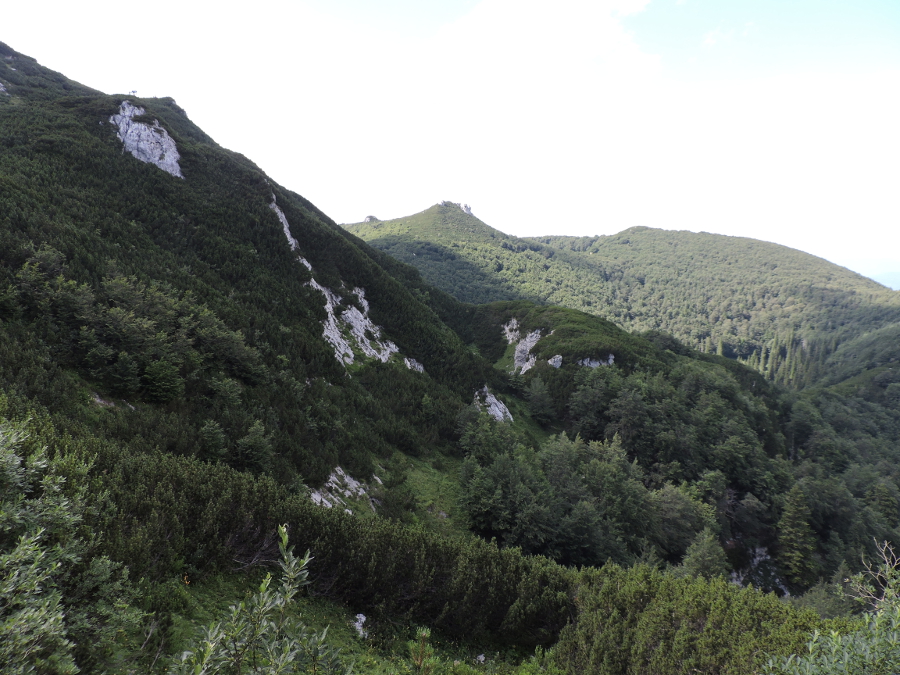
View on Mali Snežnik (1694 m), covered with Pinus mugo, 30th July 2016 
(pic by Sara Cernich).
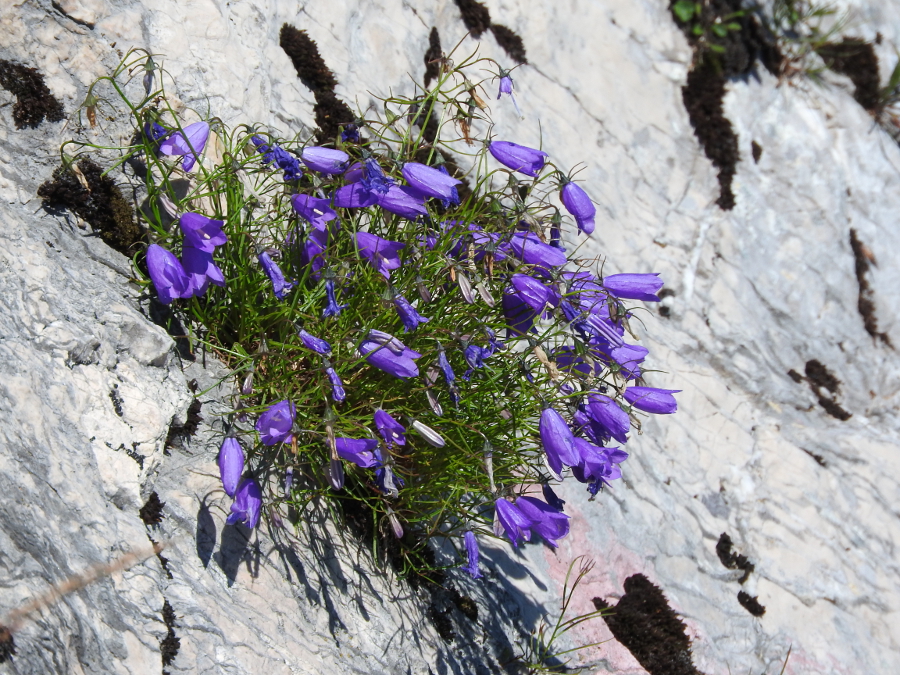
Campanula cochleariifolia, Mt. Snežnik, 30th July 2016.
Snežnik's summit with the mountain hut, 30th July 2016.
Golden Eagle Aquila chrysaetos (adult), Mt. Snežnik, 30th July 2016
 (first pic by Sara Cernich).
Mountain pine Pinus mugo, Mt. Snežnik, 30th July 2016. 
The mountain pine is covering most of the summit area 
and encroaching the precious sub-alpine grassland 
- a very biodiversity-rich habitat for plants.
(pic by Sara Cernich).
Aster alpinus, Mt. Snežnik, 30th July 2016. 
Another typical representative of alpine flora on Snežnik. 
Found sparsely around the summit.
Edraianthus graminifolius, Mt. Snežnik, 30th July 2016. 
Illyric/Balkanic species, in Slovenia being present on just a few locations 
(Snežnik is the stronghold).
Scabiosa silenifolia, Mt. Snežnik, 30th July 2016. 
In Slovenia only present on Snežnik and in Kočevsko region.
Linum julicum, Mt. Snežnik, 30th July 2016. 
Another typical alpine species with a disjunction on Snežnik.
Achillea clavennae, Mt. Snežnik, 30th July 2016. 
Common high-altitude species, 
present throughout the Alps and on Snežnik too.
Snežnik's northern slopes, 30th July 2016.
Mountain pine Pinus mugo, Mt. Snežnik, 30th July 2016. 
The very dense stands make walking on abandoned paths quite challenging. 
Here during the descend to Snežnik's north-east slopes.
Mountain pine Pinus mugo (young cones), Mt. Snežnik, 30th July 2016.
Leontopodium alpinum, Mt. Snežnik, 30th July 2016. 
Beautiful and very common around the summit. 
On Snežnik grow the largest and most beautiful specimen I've ever seen.
Dianthus barbatus, Mt. Snežnik, 30th July 2016.
Eastern slopes of Mt. Snežnik, 30th July 2016. 
Following an old hunter's path through the dense mountain pines Pinus mugo.
Alpine Salamander Salamandra atra, Mt. Snežnik, 30th July 2016.
Primeval forest, Mt. Snežnik, 30th July 2016. 
A small piece of very old and probably virgin forest is found on Snežnik's eastern slopes. 
Large beech trees lay on the ground, fallen under the pressure of windstorms. 
A large amount of fungi is present and there's dead wood everywhere - what I call paradise!
Beech Fagus sylvatica, Mt. Snežnik, 30th July 2016. 
An old tree with several such holes in it.
Beech (mast) Fagus sylvatica, Mt. Snežnik, 30th July 2016. 
Looks like a good year for beech crop - 
also noticeable by the high number of Edible Dormice Glis glis 
present in the forest at night.
Fungi sp., Mt. Snežnik, 30th July 2016. 
Amazing fungal formations are very common on fallen logs
 and some standing trees (pity I can't ID them).
Fomes fomentarius, Mt. Snežnik, 30th July 2016. 
A common fungus growing on dead and decaying beech Fagus sylvatica
Note the woodpecker's fresh feeding hole 
(most probably Black's or White-backed's).
Beech Fagus sylvatica "tower", Snežnik, 30th July 2016. 
These were perhaps the larges fungi I've ever seen. 
View south-east towards Croatia, Snežnik, 30th July 2016. 
Forests as far as the eye can see!


A few days ago I was on mount Snežnik (1796 m) in SW Slovenia with a couple of friends. Snežnik is the highest non-alpine peak in Slovenia, surrounded by extensive mixed forests (Abieti-Fagetum). The summit has a strong alpine influence, with many plants and birds, more usually associated with the Alps. For more info about the flora and biogeography of this mountain, see some previous posts here and here.
We first ascended Snežnik from its south-western slopes, then descended to the east and ascended again to the summit (after getting lost!). So we basically climbed on the mountain twice in a day, from two different directions. This way we discovered some rarely-visited (if at all!) parts of the forest (primeval patches), where we found an Alpine Salamander Salamandra atra, tons of dead wood & amazing fungi. On the bird front, the most interesting were a Golden Eagle Aquila chrysaetos (perched on a cliff) and several Ring Ouzels Turdus torquatus around the summit. In the thick mountain pine stand (Pinetum mugi dinaricum) some other birds were obvious: Lesser Whitethroat Sylvia curruca, Chiffchaff Phylloscopus collybita, Crossbill Loxia curvirostra & Bullfinch Pyrrhula pyrrhula. During the final, evening descend we first heard and then saw 3 different Ural Owls Strix uralensis (also singing "in concert") and heard a distant Pygmy Owl Glaucidium passerinum. The forest was full of Edible Dormice Glis glis (delivering all sorts of odd noises) that made us happy. Their numbers depend on beech mast production and consequently, a large density of dormice will support greater numbers of their main predators: owls. In these forests Ural Owl is the most typical dormouse-hunter, so in the coming months we will probably notice an increase in this species as well.