The last week or so has seen us back in the field for multiple raptor counts near Pivka, at the same location as in spring. The area is rather good for long hours of census, as the wide view and vicinity of the forest edge allow good birding throughout the day, even at times when raptors are not passing. The raptor passage was actually quite weak, but on the other hand rather good and "steady" at the neighbouring census location above Postojna (most birds are obviously passing there!). However we were still satisfied at the diversity of raptors. At this time of year the general migratory direction is from northeast to southwest, with the birds coming low over the Javorniki mountains, through two main "passes". The commonest migrants were Marsh Harriers Circus aeruginosus and Honey Buzzards Pernis apivorus, with the occasional Hobby Falco subbuteo, Kestrel Falco tinnunculus and Common Buzzard Buteo buteo also passing by. Among the residents, the most interesting was certainly the local pair of Golden Eagles Aquila chrysaetos, as well as a Short-toed Eagle Circaetus gallicus perched on the top of a fir. Sparrowhawk Accipiter nisus and Goshawk Accipiter gentilis, both probably residents, were also of note. A typical feature of late summer & autumn in the Dinaric mountains are also large flocks of RavensCorvus corax, patrolling the grasslands and forest edge. There was also a good passage of smaller birds with Tree Pipit Anthus trivialis, House Martin Delichon urbicum, Swallow Hirundo rustica and Swift Apus apus going overhead, while in the bushes and trees there were Willow Warbler Phylloscopus trochilus, Wood Warbler Phylloscopus sibilatrix, Spotted Flycatcher Muscicapa striata, Pied Flycatcher Ficedula hypoleuca, Whinchat Saxicola rubetra and the like. The dry grasslands were still full of Red-backed Shrikes Lanius collurio (mostly juveniles), probably involving local birds as well as migrants. In the fields between Pivka and Postojna we also had two adult White StorksCiconia ciconia.
Golden EagleAquila chrysaetos
Marsh Harrier Circus aeruginosus
Short-toed EagleCircaetus gallicus
WhinchatSaxicola rubetra perched on Cannabis sativa.
Dry limestone grasslands in the Dinaric region.
Counting migrating raptors in the hills above Pivka.
Late summer and early autumn is also the time when Nutcrackers Nucifraga caryocatactes become more prominent and more easily observable. The species is nowadays a rather scarce (or even rare) breeder in the Dinaric forests, while somehow more numerous in the Alps and is never easy to observe "properly". Although pretty shy, these birds are now rather busy searching for nuts and seeds and their distinctive calls give them away on their regular forays in the hazel stands at the edge of the forest. During our raptor counts we were able to see small numbers of them (max. a loose flock of 7), including a nice bird that posed long enough for some photos. Sharing the same food resource with the Nutcrackers was also a Red SquirrelSciurus vulgaris of the nice red morph (most squirrels here are usually dark brown or black).
NutcrackerNucifraga caryocatactes
Red SquirrelSciurus vulgaris
Although in late summer and early autumn the dry limestone meadows become really dry and consequently quite depleated in terms of wildlife, some butterflies still linger on the late-flowering plants. Typical inhabitants of such rocky and grassy habitats, exploiting the blooms of Liburnian SavorySatureja subspicata subsp. liburnica & Amethyst EryngoEryngium amethystinum include DryadMinois dryas, Great Banded GraylingBrintesia circe, ChalkhillLysandra coridon & Common BluePolyommatus icarus, Adonis BlueLysandra bellargus, Weaver's FritillaryBoloria dia, Silver-spotted Skipper Hesperia comma, as well as many Honey BeesApis mellifera.
DryadMinois dryas
Adonis BlueLysandra bellargus on Satureja liburnica
Chalkhill BlueLysandra coridon
Chalkhill BlueLysandra coridon (left) & Common BluePolyommatus icarus (right)
Honey BeeApis mellifera on Satureja liburnica
Small HeathCoenonympha pamphilus on Eryngium amethystinum
Amethyst EryngoEryngium amethystinum
Eastern Bath WhitePontia edusa
Praying MantisMantis religiosa
Wasp SpiderArgiope bruennichi
Limestone grasslands & Dinaric forests in early autumn.
During the last weekend we had family duties, babysitting our nephew & niece, so we didn't have great expectations for thrilling wildlife encounters or the like. But we were wrong. Taking the kids to see the new Mašun forest educational trail & large carnivore exibition, the trip soon transformed into a wildlife safari. Driving on the forest roads of the Snežnik & Javorniki mountains in the afternoon, we first stopped to admire some fresh and large bear's droppings in the middle of the road. Further on we spotted a Ural OwlStrix uralensis from the car. The bird was motionless, hunting from a perch and so concentrated it didn't even want to turn its head towards us. We even witnessed a (failed) hunting attempt. The kids were excited!
Ural Owl Strix uralensis
Brown Bear's dropping on a forest road.
As we continued driving, further on we noticed some unusual looking
"stumps with ears" by the side of the road, about 150 metres away from us. Upon
stopping the car we immediately realised we were looking at three Brown
BearsUrsus arctos! They were small cubs and upon seeing us, they slowly
crossed the road and disappeared into the vegetation. Their mother
should be around, we thought. Very close by there happened to be a forest
glade, so when we drove past it, we managed to spot the whole family
again, this time also seeing the large female. It all lasted a few
seconds, before the four animals disappeared once again in the thick
cover of the forest. Wow!
Driving out of the forest, we also spotted a
small herd of Red DeerCervus elaphus, a few Roe DeerCapreolus
capreolus, a FoxVulpes vulpes and a Black WoodpeckerDryocopus martius, thus rounding up perfectly this short but intense wildlife safari!
Those are not stumps...
...but cute little Brown BearsUrsus arctos!
Slowly moving away into the forest.
The mother Brown Bear making sure everything is ok.
Roe DeerCapreolus capreolus buck in the woodland behind our house (Karst).
In late summer the call of the Dinaric forests becomes irresistible and it is not unusual that we find ourselves on the Snežnik plateau on a weekly basis, or even more often so! This time Domen took Paul & Davide on a trip to the extensive and well preserved forests on the plateau's interior (check Paul's tweets for more "live from the field" action). The aim was to explore new areas of almost-primeval forest and to see some of the typical wildlife inhabiting these mountains. Among birds the most prominent species were again migrants, the commonest being Wood Warblers Phylloscopus sibilatrix (heard/seen tens of them), followed by Pied Ficedula hypoleuca and Spotted Flycatchers Muscicapa striata, while overhead were flocks of migrating House Martins Delichon urbicum and a few Honey Buzzards Pernis apivorus. Of the resident birds the most interesting were a couple of Ural Owls Strix uralensis found along the way, including a pair showing in a conifer stand, but not well enough for photography. Woodpeckers (Three-toed & White-back), the main targets of the trip, this time where nowhere to be found, also probably because of the wind, making locating birds difficult. Nevertheless we enjoyed thoroughfully in the sight of some really nice natural-looking forests.
Dry limestone meadows on the NW edge of the Snežnik plateau, with Mt. Vremščica towering in the distance.
Mt. Snežnik and its extensive forests.
Enjoying some views on a marvellous and wild dolina.
Wild dolinas are Domen's favourite.
Beech forest on a steep limestone slope.
Overlooking another dolina with Pinus mugo on the bottom.
Dead wood in the primeval forest.
Tinder FungusFomes fomentarius, an omnipresent element of beech forests (pics by Davide Scridel).
Rotting beech with Artist's BracketGanoderma applanatum.
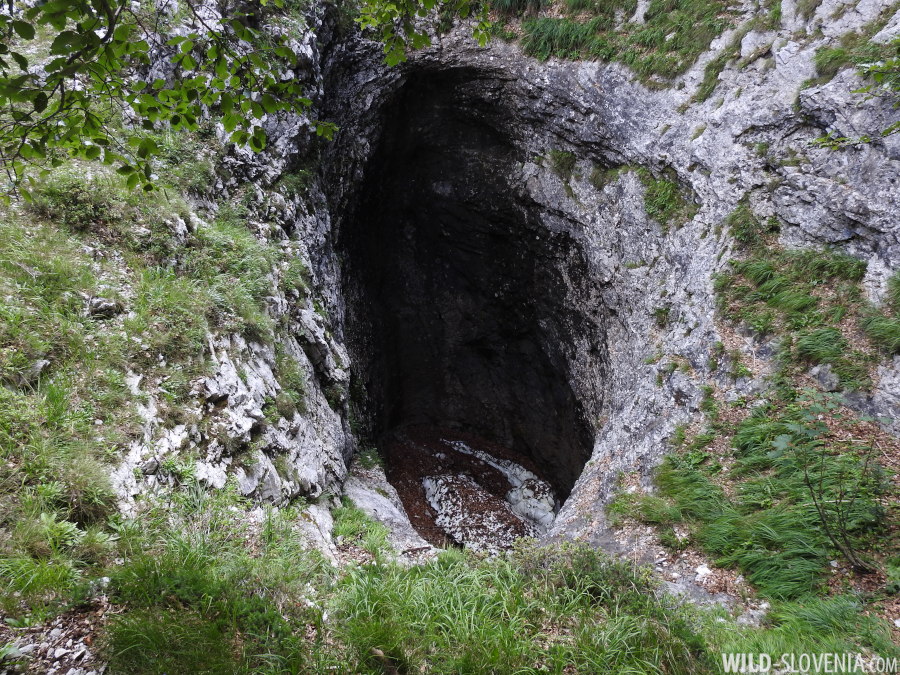
One of the several karstic sinkholes, with snow on the bottom, creating a special microclimate for alpine plants...
"Little Alpine Catchfly" Heliosperma pusillum, an alpine species found on Snežnik's summit and on the bottom of dolinas.
Alpine Yellow VioletViola biflora, another alpine element.
Alpine HoneysuckleLonicera alpigena, need to say more?
Willow GentianGentiana asclepiadea now in full bloom.
Spotted FlycatcherMuscicapa striata
BuzzardButeo buteo
A very happy boy...
...just found his trophy!
Red DeerCervus elaphus - part of a herd of 12 grazing on a meadow.
Roe DeerCapreolus capreolus
Signs of bears are all around. Here a dismembered rotten trunk...
...some claw marks...
...and some bear's droppings.
Given the abundant signs of the presence of Brown BearsUrsus arctos, we decided it was good to try our luck on a "bear hunt", staying out for the night and making the most of the twilight hours, the time when large mammals are most active. Sat quietly waiting for the sunset at the edge of the forest, we were very soon treated to the exciting apparition of a male bear, walking in full view about 250 metres away from us. The bear didn't linger much and moved on decisively into the forest, in the opposite direction from where it came. Only about 25 minutes later, a second bear, this time a young female arrived on the meadow galloping, then came to a halt, sat down for a moment, scratched a bit and continued her way. Despite both bears making only a quick appearence, we had some of the best views of these majestic animals so far, still in good light and well before twilight. What an excellent way to round up an amazing day spent in the forest!
Male Brown BearUrsus arctos
A more relaxed female Brown Bear Ursus arctos
Paul has managed to record this short video of the two bears.
A summer moon rising above the Gulf of Kvarner and illuminating the bay of Rijeka (HR).
Only a few days to the full moon.
The boys going to bed...
...while Touty tweets under the moonlight. Goodnight, to the next adventure!